The best DoorDash alternatives for restaurants are commission-free ordering on your own website, such as Menuline ($29/month), DoorDash Direct ($99/month), or ChowNow ($249/month), for your regulars, and Uber Eats or Grubhub if you want another marketplace. Switching marketplaces barely changes the rate. Moving repeat orders to your own site is what cuts DoorDash's 15–30% commission.
Per DoorDash's merchant pricing page as of October 2026, delivery orders cost 15% (Basic), 25% (Plus), or 30% (Premier). On $10,000 a month of delivery, that's $1,500 to $3,000 a month. Here's what each alternative actually costs, and when keeping DoorDash still makes sense.
Disclosure: Menuline is our product. We list competitors' published prices and their real strengths; confirm every number with the vendor before you sign.
What are the best DoorDash alternatives?
Prices per each company's published pricing page as of October 2026:
| Alternative | What the restaurant pays | Fee on the diner | Delivery | Best for |
|---|---|---|---|---|
| Menuline | $29 or $99/month, 0% commission | 5% platform fee | Pickup today; Uber drivers coming soon | Independents wanting a website, ordering, and marketing at a low flat price |
| DoorDash Direct | $99 (Boost) or $249/month (Pro), 0% commission, payment processing per order | Customers pay delivery fees | Dashers | Restaurants already running on DoorDash |
| ChowNow | $249–$449/month, $119–$499 setup, 2.95% + $0.29 per transaction | 7.5% on ChowNow app and eat.chownow.com orders only | Flex Delivery, $7.98/order | Restaurants wanting SMS, discovery channels, couriers |
| Owner.com | $249/month + 5% per order, or $499/month flat | 5% order support fee | Check with Owner.com | Restaurants wanting a done-for-you package |
| Popmenu | $179–$499/month; online ordering is an add-on | $1 per online order (restaurant or guest pays) | In-house and DoorDash delivery | Full-service restaurants focused on marketing |
| Uber Eats (marketplace) | 20% / 25% / 30% delivery, 7% pickup | App fees | Uber couriers | More discovery, not lower fees |
| Grubhub (marketplace) | 5% / 15% / 20% + 10% if Grubhub delivers + 3.05% + $0.30 | App fees | Grubhub drivers or yours | Northeast metros, corporate orders |
Notice what's not a real alternative: swapping DoorDash for Uber Eats or Grubhub. With delivery, their published rates land in the same 15–30% range (see our breakdowns of Uber Eats fees and Grubhub fees). Swapping marketplaces swaps logos, not economics.
For deeper looks at the direct-ordering options, see ChowNow pricing, Popmenu pricing, and our list of BentoBox alternatives with published prices.
Is Uber Eats or Grubhub cheaper than DoorDash?
Not meaningfully. DoorDash charges 15%, 25%, or 30% on delivery; Uber Eats charges 20%, 25%, or 30%; Grubhub charges 15%, 25%, or 30% when its drivers deliver, plus 3.05% + $0.30 processing.
| Delivered by the platform | DoorDash | Uber Eats | Grubhub |
|---|---|---|---|
| Entry plan | 15% | 20% (15% in select cities) | 15% + processing |
| Middle plan | 25% | 25% (30% on Uber One orders) | 25% + processing |
| Top plan | 30% | 30% | 30% + processing |
| Pickup | 6% | 7% | 5–20% + processing |
DoorDash is actually the cheapest of the three at the entry plan and on pickup. Being on more than one marketplace can bring in more new customers, but it won't lower what each order costs you.
Why is your own ordering the strongest alternative?
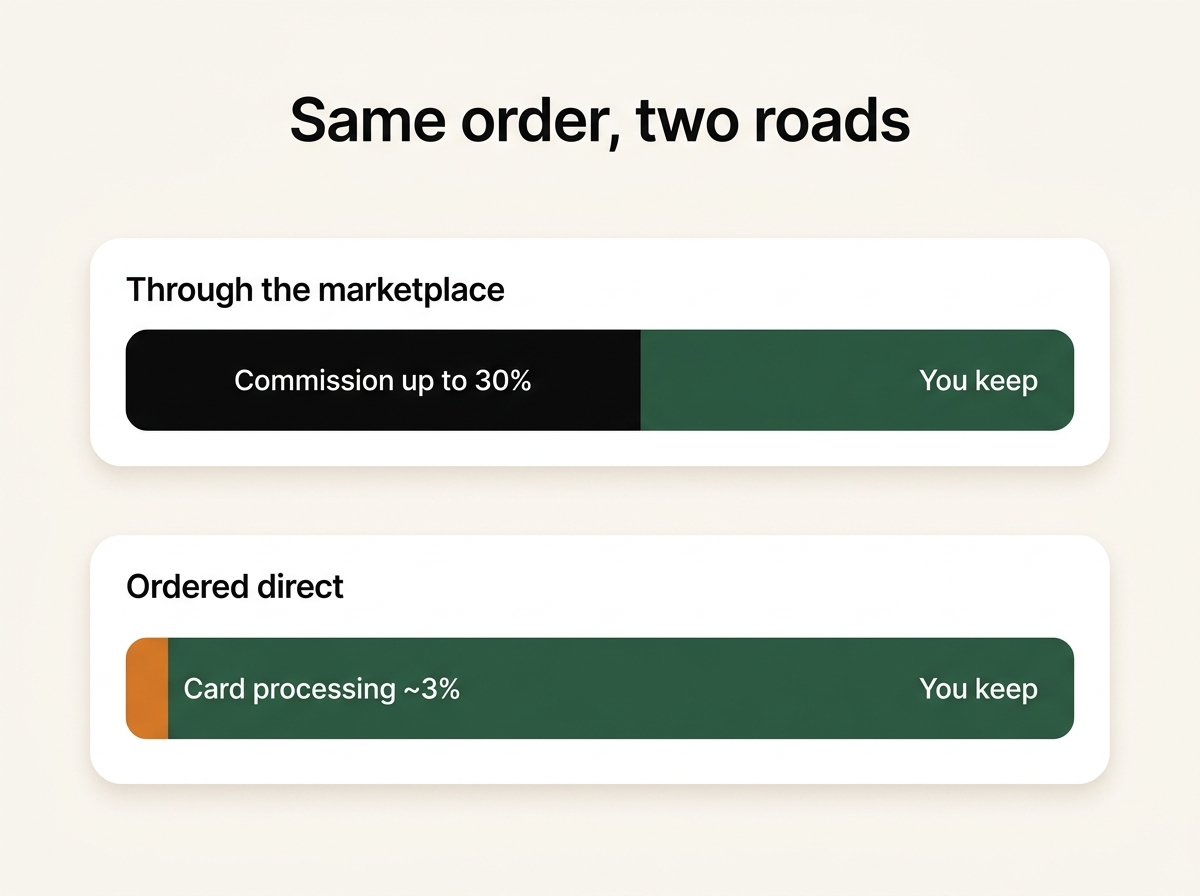
Because it fixes the actual problem: paying acquisition-level commissions on customers you've already acquired.
When someone orders on your own website:
- The restaurant pays no 15–30% commission. You pay a flat platform price and card processing, as with any card payment.
- You own the customer relationship. You get their email and order history and can bring them back, instead of the marketplace showing your customer to your competitors.
- You control the experience: your menu, your photos, your prices, your brand.
The old objection was that building this was expensive and slow. It isn't anymore. Menuline gives you a restaurant website with commission-free online ordering, an online menu, and loyalty rewards for $29/month (Starter) or $99/month (Growth), both $1/month for the first 3 months, month-to-month with no contract. AI-powered email marketing and a branded app are on Growth. The restaurant pays 0% commission; diners pay a 5% platform fee at checkout. Ordering is pickup today; delivery with Uber drivers is coming soon. See pricing.
How do you get orders without DoorDash?
Having your own channel is step one. Getting orders into it is the real work.
1. Win the search for your name
When someone Googles your restaurant, they see your Google Business Profile. Make sure the ordering link on that profile points to your website and is set as the preferred option. This one change redirects your highest-intent traffic into your 0% channel. Our guide to adding online ordering to Google walks through it step by step.
2. Convert DoorDash customers into direct customers
Every DoorDash bag can carry a QR-code card: "Order direct next time and get a reward." You paid the commission once to meet this customer; don't pay it on every order after.
3. Follow up automatically
Repeat business is where the margin is. Email follow-ups, loyalty rewards, and win-back campaigns turn one-time customers into regulars. Menuline includes loyalty and email marketing on every plan, with AI marketing on Growth.
4. Make your own site genuinely good
If your website is slow, hard to order from, or invisible on Google, customers will default to the app. A fast site with easy ordering removes the reason to open DoorDash at all.
What does the hybrid math look like?
Say you do $12,000 a month in online orders, all through DoorDash Plus at 25%:
| Scenario | DoorDash commission | Direct platform cost | Total cost |
|---|---|---|---|
| 100% DoorDash | $3,000 | $0 | $3,000/mo |
| 50% direct / 50% DoorDash | $1,500 | $99 (Menuline Growth) | $1,599/mo |
| 80% direct / 20% DoorDash | $600 | $99 | $699/mo |
Moving half your volume to your own ordering saves about $1,400 a month ($16,800 a year) in restaurant-side fees, before card processing on the direct orders, without giving up the new customers DoorDash brings. Since Menuline ordering is pickup only today, the orders to move first are pickup orders and regulars.
When does keeping DoorDash make sense?
Honestly, most of the time. DoorDash does two things your own website can't do on day one:
- Discovery. Hungry, undecided people browse DoorDash. If you're new or in a crowded area, that shelf space brings customers you'd never reach otherwise.
- Delivery logistics. If you don't have drivers, DoorDash's courier network is hard to replace.
Its terms are also easy to live with: no monthly fee, no contract, and you can switch plans any time. That's why the winning strategy usually isn't "quit DoorDash." It's "stop giving DoorDash your regulars." Keep the marketplace as a paid discovery channel, often on Basic at 15%, and move everyone else to your own ordering. We work through the full decision in Are Delivery Apps Worth It?
The bottom line
The best DoorDash alternative is your own commission-free ordering, from $29/month with Menuline, $99/month with DoorDash Direct, or $249/month with ChowNow. Uber Eats and Grubhub are alternatives for reach, not savings: their rates land in the same 15–30% range. Most restaurants should keep DoorDash for discovery and move regulars to a channel they own.
Start by seeing how your restaurant looks to people searching for it right now. The free Menuline AI grader audits your website, Google presence, and ordering setup in about a minute.