Ask ten restaurant owners whether delivery apps are worth it and you'll get ten emotional answers, usually correlated with last month's commission statement. Let's replace the emotion with a per-order P&L and a simple framework: delivery apps are a customer-acquisition channel priced like one. They're worth it when they're acquiring, and not when they're not.
What does a delivery app order actually net you?
Start with the real math. Marketplace commissions run 15–30% on delivery per the platforms' published 2026 pricing (DoorDash, Uber Eats, Grubhub). Here's a $35 order on a typical 25% tier, versus the same order direct:
| Per-order P&L | App order (25%) | Direct order |
|---|---|---|
| Subtotal | $35.00 | $35.00 |
| Commission | −$8.75 | $0.00 |
| Card processing (~3%) | n/a | −$1.05 |
| Net revenue | $26.25 | $33.95 |
| Food cost (~32%) | −$11.20 | −$11.20 |
| Packaging | −$1.50 | −$1.50 |
| Direct labor (est.) | −$3.50 | −$3.50 |
| Contribution before overhead | $10.05 | $17.70 |
Both orders are "profitable" before overhead, but the app order contributes 43% less. Now allocate fixed costs (rent, insurance, salaried labor, utilities). If your overhead runs $8–12 per order at your volume, the app order hovers around break-even while the direct order still clears meaningfully.
One number to remember: the app order and the direct order cost you the same to produce. The only difference is who takes a cut on the way out.
Run your own numbers: the free delivery app fee calculator shows what marketplace commissions cost you per month and year next to commission-free direct ordering — just enter your orders, average ticket, and tier.
So when is that cut worth paying? When the order is acquisition
Here's the case for delivery apps, stated as strongly as it deserves, because it's real:
- Discovery demand exists and you can't reach it otherwise. Millions of people open a delivery app hungry and undecided. Your website will never be in front of them; a marketplace listing is.
- A first order at break-even is a good trade. If a new customer's first $35 order nets you roughly nothing but starts a relationship worth hundreds of dollars a year, the commission worked exactly like a marketing budget should.
- Marginal orders in dead hours help. A near-break-even order at 3pm Tuesday still contributes to fixed costs you're paying anyway.
- Logistics without hiring drivers. If delivery matters in your market and you have no fleet, the apps solve a genuinely hard problem.
If your app orders are mostly new names, the apps are earning their commission.
And when is it not worth it? When the order is loyalty
The same 25% that's reasonable on a stranger's first order is unreasonable on your regular's fiftieth. Nothing was discovered. No relationship was created. In fact, the marketplace owns the customer data and can advertise your competitors to your customer at checkout.
Look at your app orders honestly:
- How many come from customers searching your name?
- How many names do you recognize?
- How many would have called or walked in five years ago?
That share of volume is loyalty traffic paying acquisition prices. On $8,000/month of such orders at 25%, you're spending $2,000/month ($24,000/year) to rent access to your own customers.
The framework: pay for discovery, never for loyalty
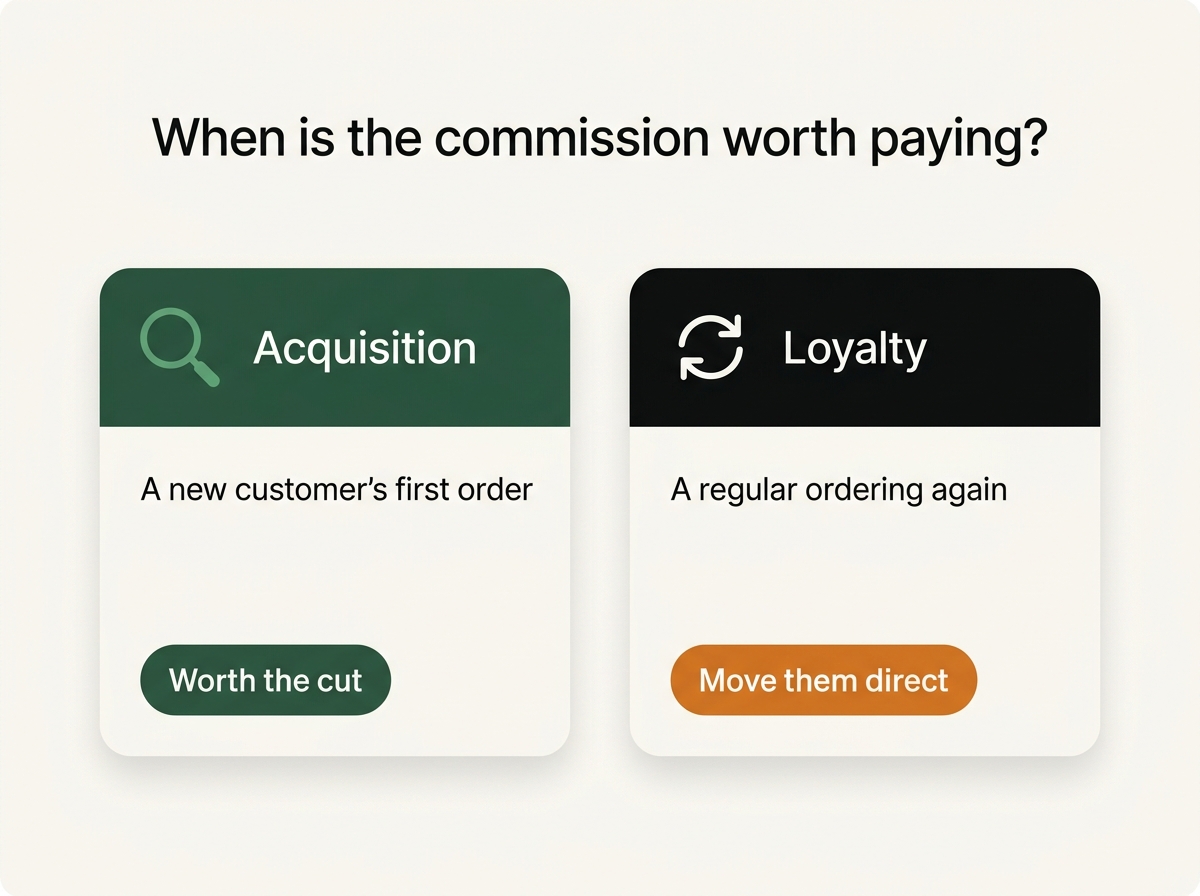
The answer to "are delivery apps worth it?" is a portfolio decision, not a yes/no:
- Keep a marketplace listing as your discovery channel. Consider a lower tier if branded search drives most of your app volume; see How to Reduce Delivery App Fees.
- Build a direct channel where loyalty lives. Your own website and app: 0% commission, your customer data, your margins.
- Move customers from one to the other, deliberately. Bag inserts, a direct ordering link on your Google Business Profile, loyalty rewards that only accrue direct.
This is the funnel strategy we detail in First-Party vs Third-Party Delivery.
What does the direct side cost?
The direct channel's economics are what make the framework work. Menuline provides an AI-built restaurant website with commission-free online ordering, a branded iOS/Android app, and AI marketing and loyalty automation for $29/month (Starter) or $99/month (Growth). It's $1/month for the first 3 months, with 0% commission on every plan and no long-term contracts. See pricing.
At those prices, shifting even one $35 order per day from a 25% marketplace tier to direct saves more than the Starter plan costs. Everything beyond that is recovered margin.
The bottom line
Delivery apps are worth it for exactly one job. They are an expensive, effective way to meet new customers, and an expensive, pointless way to serve existing ones. Restaurants that treat the commission as an acquisition budget, and route loyalty through their own channel, get the best of both.
Want to see how much of your volume is loyalty traffic paying acquisition prices? Run the free Menuline AI grader. It audits your online presence and ordering setup in about a minute.