Toast is one of the most popular restaurant POS systems in the US, and one of the most misunderstood on price. The advertised numbers start at $0/month, but almost nobody pays $0. Here's how Toast's pricing actually works, per its published pricing as of 2026, and how to figure out what you'd pay.
What are Toast's published plans?
Toast structures pricing in three tiers, per its published pricing as of 2026:
| Plan | Software cost | The trade-off |
|---|---|---|
| Starter Kit | $0/month | New customers and single locations only; covers the first terminal, more cost extra |
| Point of Sale | ~$69/month | Lower processing than the free tier; hardware and add-ons extra |
| Build Your Own | Custom quote | Full feature set, priced to your configuration |
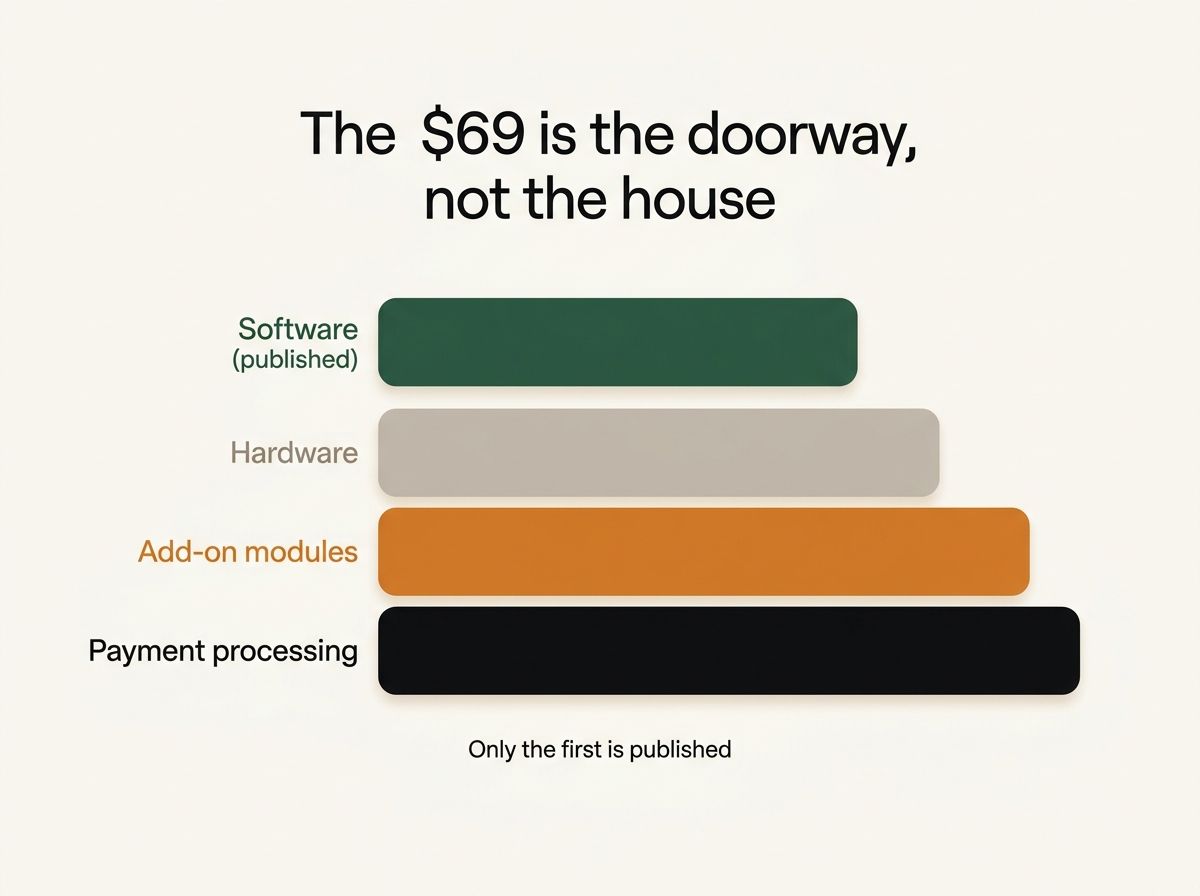
The pattern to understand: Toast monetizes through software, hardware, add-ons, and payment processing simultaneously. The headline software price is the smallest of the four. It's also worth knowing that these three figures are essentially all Toast publishes; processing rates, add-on prices, and hardware costs are quote-based, so any specific number you find elsewhere is a third-party estimate rather than Toast's published rate.
Why isn't the $0 plan actually free?
Because processing is the price. On the Starter Kit, Toast charges higher card processing rates than on paid plans. The difference is commonly estimated at roughly half a percentage point or more per transaction, plus a per-transaction fee.
Half a point sounds small. On $40,000/month of card sales, an extra ~0.6% is about $240/month, more than three times the cost of the $69 paid plan. The free tier is genuinely useful for very low-volume operations; past modest volume, it's usually the most expensive option in disguise.
This is worth internalizing because it's the same lesson as delivery-app commissions: percentage-based pricing scales with your success, while flat pricing doesn't.
What else goes on the bill?
The base plan is a starting point. A realistic Toast setup typically adds:
- Hardware: terminals, handhelds, kitchen display screens, printers. Purchased upfront or financed; this is often the largest early cost.
- Add-on modules: online ordering (sold as the Digital Storefront suite, split into Essentials and Pro tiers), email marketing, loyalty, gift cards, payroll, and more are priced separately, generally by custom quote. Toast's own online ordering is commission-free, so the cost is the add-on plus processing rather than a cut of each order.
- Payment processing: on every card transaction, at rates that depend on your plan.
- Installation and onboarding: depending on configuration.
None of this makes Toast a bad deal. It's a full operating system for a restaurant, and it's priced like one. But when owners compare "Toast at $69" to other tools, they're usually comparing the doorway, not the house. Real-world Toast bills typically land at several hundred dollars a month once hardware amortization, add-ons, and processing deltas are counted.
When is Toast worth it?
Honest answer: often. Toast makes the most sense when:
- You need a true POS: front-of-house terminals, kitchen screens, staff management, table service workflows.
- You want one vendor for everything: POS, payments, payroll, and ordering. That only pays off if you'll actually use the breadth.
- You're high-volume and can negotiate processing while making full use of the hardware.
If you're opening a full-service restaurant and need the whole operating system, Toast belongs on your shortlist. Our Menuline vs Toast comparison goes deeper.
When is Toast more than you need?
Here's the case where owners overspend: you already have a POS you like (or a simple setup that works), and what you actually want is online presence, a good website, direct online ordering, and marketing that brings customers back.
Buying a full POS platform to get a website and ordering page is like buying a truck to get the cupholder. The add-on stacking works against you: base plan + online ordering module + marketing module, each priced separately.
For that job, Menuline covers the entire online layer: an AI-built, SEO-optimized website, commission-free online ordering (0% on every plan), a branded iOS/Android app, and AI marketing and loyalty. It costs $29/month (Starter) or $99/month (Growth), with a $1/month promo for the first 3 months and no long-term contracts. See pricing.
| If you need... | Consider |
|---|---|
| Full POS + payments + payroll | Toast (or another POS) |
| Website + ordering + marketing only | Menuline, $29–$99/month flat |
| Both | Keep your POS; add Menuline for the online layer |
How do you estimate your real Toast cost?
Before signing, price out your actual configuration:
- Count hardware: every terminal, handheld, and kitchen screen.
- List the add-ons you'd genuinely use, then get each one quoted.
- Model processing at your volume: ask for the exact rates on your plan and multiply against your monthly card sales. Compare the free tier's higher rate against paid plans at your volume.
- Compare against your current stack's total: not just software vs software.
The bottom line
Per Toast's published pricing as of 2026: $0/month to start (with higher processing), roughly $69/month for the core POS plan, and custom pricing beyond, plus hardware, add-ons, and processing that determine the real bill. It's fair pricing for a full restaurant operating system.
But if the problem you're solving is "my restaurant needs to win online" rather than "my restaurant needs a new POS," you can solve it for $29–$99/month flat. Run the free Menuline AI grader to see where your online presence stands before you spend POS money on a website problem.