Uber Eats charges restaurants 20% (Lite), 25% (Plus), or 30% (Premium) of each delivery order, and 7% on pickup if you validate that your in-app prices match in-store (10% if you don't), per its US pricing page as of October 2026. Lite drops to 15% in about a dozen cities, Plus adds 5% on Uber One orders, and there's no monthly fee.
That covers the headline rates. The rest of this page covers the fine print on each plan, the per-order and per-month math, and how Uber Eats stacks up against DoorDash, so you can pick a plan on numbers instead of on the sales pitch.
What are Uber Eats' fees for each plan?
Per Uber Eats' published US marketplace pricing as of October 2026:
| Plan | Delivery fee | Pickup fee | Uber One orders | Intro offer |
|---|---|---|---|---|
| Lite | 20% (15% in select cities) | 7% (10% without validated pricing) | Not eligible | None listed |
| Plus | 25% | 7% | Optional, +5% (30% total) | 0% for 30 days |
| Premium | 30% | 7% | Included at no extra cost | 0% for 30 days |
| Self-Delivery | 15% (your drivers) | 7% | n/a | n/a |
The fee is a percentage of the order, and Uber Eats lists payment processing, order management, 24/7 support, and sales analytics as included on every marketplace plan. There's no separate card-processing line, unlike Grubhub's 3.05% + $0.30.
Run your own numbers: the free delivery app fee calculator shows what marketplace commissions cost you per month and per year next to commission-free direct ordering.
What does each Uber Eats plan include?
Lite (20%) gets you "discoverability in the Uber Eats app when customers search for your store." In practice, customers who already know your name can find you. You don't get Uber One members.
Plus (25%) adds wider discoverability, a lower delivery fee shown to customers, a boost for your ads and offers, and the option to join Uber One. Uber Eats says Uber One members order twice as often as non-members. Joining costs an extra 5% on those orders.
Premium (30%) adds the highest discoverability, the lowest customer delivery fees, Uber One at no extra cost, ad spend matching up to $100 a month, a free premium menu photo package, a complimentary one-year Uber One membership, and a minimum of 20 orders a month for your first 6 months.
Self-Delivery (15%) is for restaurants with their own drivers. You can still send farther orders, or overflow when your drivers are busy, to Uber's couriers at 25%.
What's in the fine print?
The footnotes on the pricing page are where the rules live:
- The 7% pickup rate needs proof. Uber Eats says it's "conditioned on submission of proof that pricing for in-app pickup is the same as in-store." Mark up your app menu and pickup costs 10%.
- Lite's lower rates are city-specific. Uber Eats lists 15% delivery in Portland, Washington DC, Minneapolis, New York City, Philadelphia, New Jersey, Los Angeles, Palm Springs, San Francisco, Seattle, Spokane, Alameda County, and Beverly Hills, several with lower pickup rates too.
- Premium's 20-order protection has conditions. You must have fewer than 3 cancellations or missed orders and be online on Uber Eats for at least 95% of your store hours, and it only covers the first 6 months.
- The 30-day 0% intro on Plus and Premium covers delivery and pickup fees on orders in your first 30 days.
- US only. The plans cover the US including Alaska and Hawaii, but not Puerto Rico.
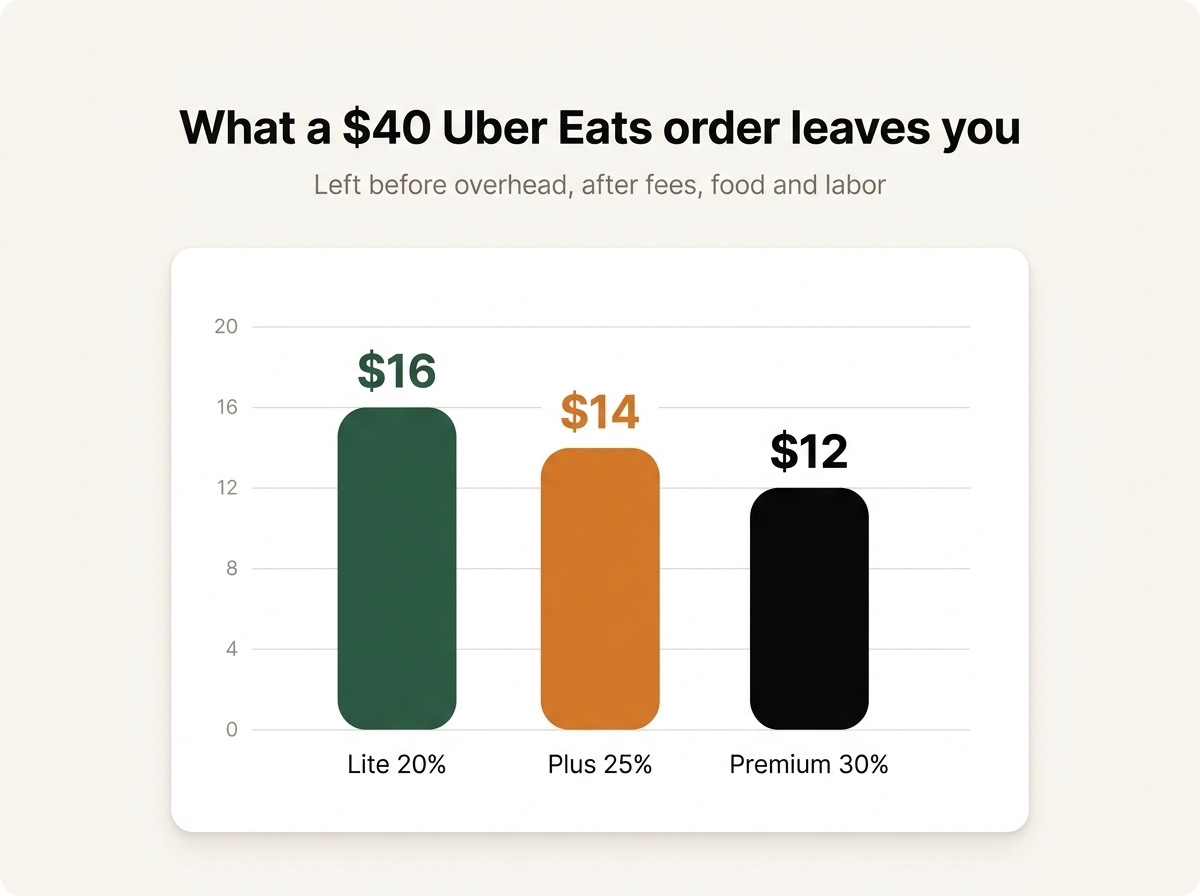
What does a $40 order actually cost you?
| Lite (20%) | Plus (25%) | Premium (30%) | |
|---|---|---|---|
| Order subtotal | $40.00 | $40.00 | $40.00 |
| Uber Eats marketplace fee | −$8.00 | −$10.00 | −$12.00 |
| You receive | $32.00 | $30.00 | $28.00 |
| Food cost (about 30%) | −$12.00 | −$12.00 | −$12.00 |
| Packaging and labor (est.) | −$4.00 | −$4.00 | −$4.00 |
| Left before overhead | $16.00 | $14.00 | $12.00 |
An Uber One order on Plus costs $12.00, the same as Premium. The same $40 as pickup costs $2.80 at 7%, or $4.00 at 10% without validated pricing.
Rent, utilities, insurance, and payroll still come out of that last line. On Premium, a $40 order often nets an independent restaurant close to nothing, which is why marketplace volume isn't automatically extra profit.
What does Uber Eats cost per month?
Say you do $8,000 a month in Uber Eats delivery: 200 orders at a $40 average.
| Plan | Monthly fees | Per year |
|---|---|---|
| Self-Delivery (15%, your drivers) | $1,200 | $14,400 |
| Lite (20%) | $1,600 | $19,200 |
| Plus (25%, no Uber One) | $2,000 | $24,000 |
| Plus with Uber One, 40% of orders from members | $2,160 | $25,920 |
| Premium (30%) | $2,400 | $28,800 |
A useful way to see Plus with Uber One: your real rate is 25% plus 5% times your Uber One share. If half your orders come from members, Plus costs 27.5%.
Pickup changes the math more than plan choice. Moving 50 of those 200 orders to pickup at 7% cuts $500 in fees on Plus to $140, a saving of $360 a month.
Which has lower commission fees, DoorDash or Uber Eats?
DoorDash is slightly cheaper for most restaurants: its entry plan is 15% on delivery versus 20% for Uber Eats Lite (outside the 15% cities), pickup is 6% versus 7%, and the top tiers tie at 30%.
| Per DoorDash and Uber Eats US pricing pages, Oct 2026 | DoorDash | Uber Eats |
|---|---|---|
| Entry plan, delivery | Basic 15% | Lite 20% (15% in select cities) |
| Middle plan, delivery | Plus 25% | Plus 25% (30% on Uber One orders) |
| Top plan, delivery | Premier 30% | Premium 30% |
| Pickup | 6% | 7% (10% without validated pricing) |
| Self-delivery plan | Not on the plan cards | 15% |
| Card processing | Included | Included |
| Monthly fee | None | None |
| Order guarantee | Premier: 20 orders/month, first 6 months | Premium: 20 orders/month, first 6 months |
Two places where Uber Eats can come out ahead: if you're in one of the cities where Lite is 15%, the entry plans tie; and if you deliver yourself, Uber Eats publishes a 15% self-delivery plan. Rates matter less than reach, though. The better platform is whichever brings you more new customers in your neighborhood, which you can only learn by testing. Full DoorDash details are in our DoorDash fees breakdown and DoorDash commission rates by plan; Grubhub's split structure is in Grubhub fees.
Why do the higher Uber Eats plans exist?
Because visibility is the product. On Lite, mostly people who already know your name find you. Plus and Premium put you in the feed where undecided, hungry customers browse, lower their delivery fee, and add Uber One members.
That's genuinely valuable for acquiring new customers. The problem is the fee doesn't distinguish a first-time discovery from the fiftieth order from your biggest fan. You pay discovery prices on every order.
A quick test: check your Uber Eats analytics for how many orders come from searches for your restaurant's name. If that's most of your volume, Lite captures it for less.
What's the alternative for repeat orders?
Ordering on your own website, where the restaurant pays no commission.
Menuline gives you a restaurant website with commission-free online ordering, an online menu, and loyalty rewards for $29/month (Starter) or $99/month (Growth), both $1/month for the first 3 months, month-to-month with no contract. AI-powered email marketing and a branded app are on Growth. The restaurant pays 0% commission. Diners pay a 5% platform fee at checkout, and standard card processing applies to online payments. Ordering is pickup today; delivery with Uber drivers is coming soon.
On the same $8,000 a month:
| Channel | Restaurant's monthly cost |
|---|---|
| Uber Eats Premium (30%) | $2,400 |
| Uber Eats Lite (20%) | $1,600 |
| Menuline Growth | $99 (plus card processing) |
Because Menuline ordering is pickup only today, the orders it replaces are your pickup and repeat orders, not delivery you'd still need couriers for. See pricing.
When is Uber Eats the right choice?
For most restaurants, staying on Uber Eats makes sense in some form. Its reach, especially among Uber One members, is a real discovery engine, and its courier network solves delivery you may not want to build. Self-Delivery at 15% is a strong deal if you have drivers, and Premium's 20-order guarantee lowers the risk for a brand-new restaurant.
The honest strategy is a hybrid:
- Stay listed, often on the lowest plan that still brings new customers.
- Make your own ordering link the first one on Google so people searching your name order direct. Our guide to adding online ordering to Google walks through it.
- Convert app customers with bag inserts, loyalty rewards, and email follow-ups.
Every regular you move to your own channel turns a 20–30% fee into a flat monthly cost. The tactics are in How to Reduce Delivery App Fees.
The bottom line
Per Uber Eats' published US pricing as of October 2026, restaurants pay 20%, 25%, or 30% on delivery (Lite at 15% in select cities, Plus at 30% on Uber One orders), 7% on pickup with validated in-store pricing, and 15% if they self-deliver, with no monthly fee and card processing included. DoorDash is a little cheaper at the entry tier and on pickup; the top tiers are identical.
To see how many of your orders could be flowing through your own channel instead, run the free Menuline AI grader.