Grubhub's fees look different from DoorDash's and Uber Eats' on paper: a lower-sounding "marketing commission" plus separate delivery and processing fees. Stack them up, though, and the total lands in familiar territory. Here's the full breakdown, based on Grubhub's published pricing as of 2026, and the math on what an order really costs you.
How is Grubhub's fee structure different?
Where DoorDash and Uber Eats quote one all-in commission per tier, Grubhub splits its charges into three parts. Per Grubhub's published pricing as of 2026:
| Fee | Amount | When it applies |
|---|---|---|
| Marketing commission | 5–20% of each order, by package | Every marketplace order |
| Delivery fee | 10% | Only when Grubhub's drivers deliver |
| Order processing fee | 3.05% + $0.30 | Every order |
The marketing commission is what you pay for placement and promotion on the marketplace. The higher your package, the more visibility Grubhub gives you. The delivery fee is avoidable if you self-deliver with your own drivers.
Run your own numbers: the free delivery app fee calculator shows what marketplace commissions cost you per month and year next to commission-free direct ordering — just enter your orders, average ticket, and tier.
What does a Grubhub order actually cost in total?
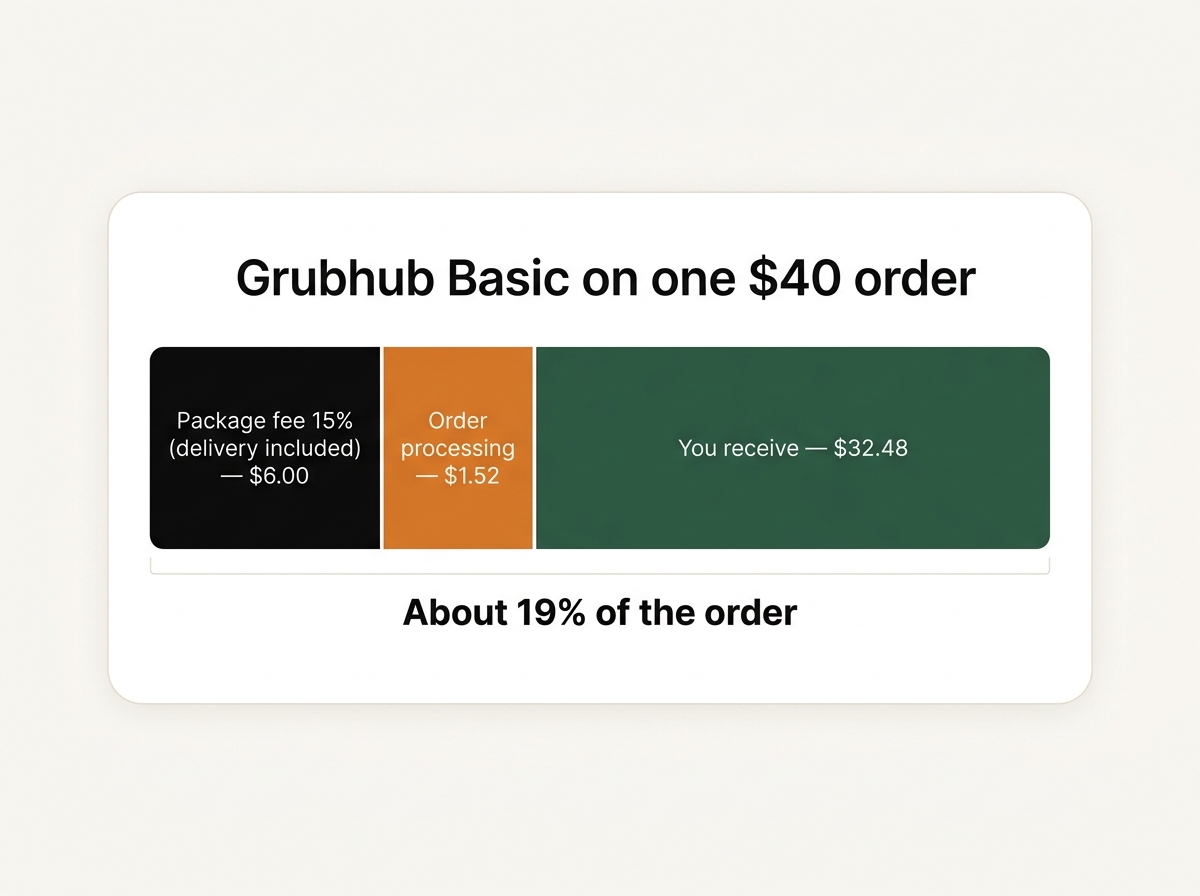
The split structure makes Grubhub's headline rates sound cheaper than the competition. One thing to get right before doing the math: Grubhub's named packages are quoted inclusive of the 10% delivery fee, so you shouldn't add delivery on top of the package rate. Here's a $40 delivered order on Grubhub Basic, which starts at 15% including delivery:
| Line | Amount |
|---|---|
| Order subtotal | $40.00 |
| Grubhub Basic package, 15% (delivery included) | −$6.00 |
| Order processing (3.05% + $0.30) | −$1.52 |
| You receive | ~$32.48 |
| Food cost (~30%) | −$12.00 |
| Packaging & labor (est. ~$4) | −$4.00 |
| Left before overhead | ~$16.48 |
That's about 19% of the order in fees on the entry package, which is genuinely lower than DoorDash's published 25–30% upper tiers and Uber Eats' 25–30%. Grubhub's packages are all quoted as "starting at," though, so your actual rate can land higher: Plus starts at 20% and Premium at 25%, and at those tiers the total lands squarely in the same range as the other two.
At the bottom end, a 5% marketing rate with self-delivery is genuinely cheaper, but the low rate also buys you the least visibility, which is the main reason to be on a marketplace at all.
Which Grubhub package should you choose?
The honest framing: the marketing commission is an advertising budget. Ask what you're buying with it.
- If customers mostly find you on Grubhub by searching your name, you're paying for placement you don't need; a low package captures those orders at minimal cost.
- If you rely on Grubhub to put you in front of undecided browsers, higher packages can earn their keep, but track whether the incremental orders are new customers or regulars who would have ordered anyway.
- If you have your own drivers, self-delivery removes the 10% fee and is one of the few genuinely free wins in marketplace economics.
Why are you paying marketing commission on your regulars?
This is the structural problem with every marketplace, and Grubhub's fee naming makes it unusually visible: it's literally called a marketing commission, yet you pay it on the customer who has ordered from you thirty times.
Marketing spend is supposed to acquire customers. Once acquired, they should cost you almost nothing to serve. On a marketplace, they never do.
What does direct ordering cost instead?
On your own website, there's no marketing commission, no delivery-fee stacking on pickup, and no marketplace between you and your customer.
Menuline gives you an AI-built restaurant website with commission-free online ordering, a branded iOS and Android app, and AI marketing and loyalty automation for $29/month (Starter) or $99/month (Growth), with $1/month for the first 3 months, 0% commission on every plan, and no long-term contracts. See pricing.
On $6,000/month of online orders:
| Channel | Monthly cost |
|---|---|
| Grubhub Premium tier, ~25% all-in | ~$1,500 |
| Grubhub Basic tier, ~19% all-in | ~$1,140 |
| Grubhub, low rate self-delivery (~8% all-in) | ~$480 |
| Menuline Growth (flat) | $99 |
When is Grubhub still worth keeping?
Being fair: Grubhub retains a strong customer base in certain metros (it has historically been especially strong in northeastern cities) and among corporate accounts. If a meaningful share of your orders comes from Grubhub customers you'd never otherwise reach, the marketing commission on those orders is defensible acquisition spend.
The play isn't necessarily to leave. It's to stop routing repeat business through it. Fix your Google Business Profile ordering link, add direct-ordering inserts to marketplace bags, and let loyalty rewards pull regulars to your own site. The full playbook is in How to Reduce Delivery App Fees.
The bottom line
Per Grubhub's published pricing as of 2026: named packages starting at 15% (Basic), 20% (Plus), and 25% (Premium), each quoted inclusive of the 10% delivery fee, plus 3.05% + $0.30 order processing. That puts the entry package near 19% all-in and the higher tiers in the same 25–30% range as the other big marketplaces. To see how much of that volume you could serve commission-free, run the free Menuline AI grader. It takes about a minute.