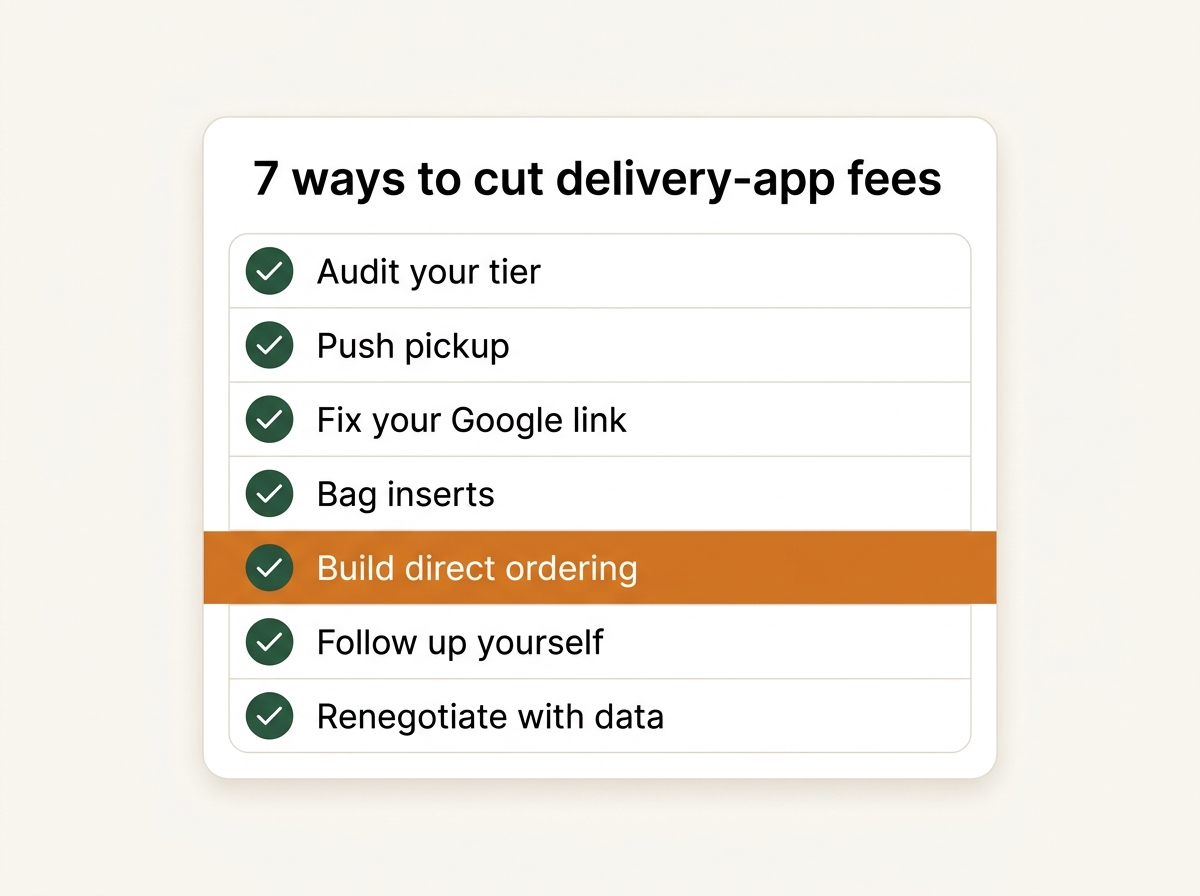
You can't avoid fees on orders placed inside DoorDash, Uber Eats, or Grubhub, but you can cut them hard. Pickup costs 6–7% instead of 15–30% for delivery, the cheapest plan often captures the same orders, and orders on your own website carry no marketplace commission at all. Here are seven tactics, ordered by effort, with the math on a $10,000-a-month restaurant.
Every rate below is from each company's published US pricing page as of October 2026. Delivery app fees aren't one number. They're a stack of choices: which plan you're on, which orders go through the app, and whether your regulars have a reason to order anywhere else.
How do you avoid delivery app fees?
The short version, by how much each lever moves:
| Lever | Typical saving | Effort |
|---|---|---|
| Move regulars to your own ordering | The full 15–30% on each order moved | Medium, ongoing |
| Push pickup instead of delivery | About 9 to 24 points per order | Low |
| Drop to a cheaper plan | 5 to 15 points on remaining orders | Low |
| Self-deliver where you have drivers | 10 to 15 points per order | High |
| Negotiate | Varies; works best at volume | Low |
The current rates you're working with:
| Entry plan | Middle plan | Top plan | Pickup | |
|---|---|---|---|---|
| DoorDash | 15% | 25% | 30% | 6% |
| Uber Eats | 20% (15% in select cities) | 25% (30% on Uber One orders) | 30% | 7% (10% without validated pricing) |
| Grubhub | 5% + 10% delivery | 15% + 10% delivery | 20% + 10% delivery | Marketing commission only |
Grubhub also adds 3.05% + $0.30 per order for processing; DoorDash and Uber Eats include processing in their rates. Full breakdowns: DoorDash, Uber Eats, Grubhub.
Run your own numbers: the free delivery app fee calculator shows what marketplace commissions cost you per month and per year next to commission-free direct ordering.
1. Audit your marketplace plan: are you paying for reach you don't need?
Higher plans buy visibility: a wider delivery radius, better placement, and access to subscription members (DashPass, Uber One, Grubhub+). They don't lower your rate.
So ask the question almost nobody asks: how many of your marketplace orders come from people searching your restaurant by name? Those customers would find you on the cheapest plan. If they're most of your volume, you're paying 25–30% to "discover" people who already know you.
Check your marketplace analytics. If branded searches dominate, drop a plan and watch for a month. DoorDash lets you switch any time with no penalty (the change takes up to five business days) and suggests running a plan for two to three weeks before judging it. Our DoorDash commission rates guide shows how much extra volume a higher plan needs to break even: about 22% more delivery sales for Plus and 38% for Premier, at a 30% food cost.
2. Push pickup wherever you can
Pickup is the cheapest marketplace order there is: 6% on DoorDash and 7% on Uber Eats, versus 15–30% for delivery. On Grubhub, pickup skips the 10% delivery fee, so you pay only the marketing commission and processing.
On a $40 order, DoorDash Plus delivery costs $10.00 in commission. The same order as pickup costs $2.40.
One fine-print trap: both low pickup rates depend on price matching. DoorDash's 6% requires pickup menu prices that match in-store, and Uber Eats' 7% requires proof that in-app pickup prices match in-store (otherwise it's 10%). If you mark up your app menu to cover delivery commission, keep pickup prices at in-store levels.
Promote pickup in your listings, keep quoted pickup times accurate, and try pickup-only specials. If you have your own drivers, self-delivery is the next cheapest: Uber Eats publishes a 15% self-delivery plan, and Grubhub charges no delivery fee when you deliver.
3. Point your Google Business Profile at your own ordering page
When customers Google your restaurant, your Google Business Profile is usually the first thing they see, and its "Order online" button often defaults to third-party apps. You can add your own ordering link and make it the preferred option.
This is your highest-intent traffic: people looking for you. Sending it to your own site instead of an app turns 15–30% commission orders into 0% commission orders without asking customers to change anything. Our step-by-step guide to adding online ordering to Google shows exactly where the setting lives, and the Google Business Profile guide covers the rest of the profile.
4. Put a direct-ordering insert in every bag
Every delivery bag reaches a proven customer. A card with a QR code that says "Order direct next time and earn rewards" costs pennies and speaks to exactly the people you want to move.
Make the offer concrete: a free item on their first direct order, or loyalty points that only exist on your own site. You already paid the marketplace once to meet this customer. The insert is how you stop paying every time they come back.
5. Build a direct channel worth switching to
None of these tactics work if your own ordering is worse than the app. The bar: a fast website, a menu that's easy to browse on a phone, checkout in under a minute, and accurate pickup times.
This used to take an agency and months. Menuline builds it for you: a restaurant website with commission-free online ordering, an online menu, and loyalty rewards, for $29/month (Starter) or $99/month (Growth), both $1/month for the first 3 months, month-to-month with no contract. AI-powered email marketing and a branded app are on Growth. The restaurant pays 0% commission; diners pay a 5% platform fee at checkout, and standard card processing applies. Ordering is pickup today; delivery with Uber drivers is coming soon. See pricing.
6. Follow up like you own the relationship, because you do
Marketplaces keep the customer data. Your own channel gives it to you. Use it: email follow-ups, loyalty rewards, and win-back campaigns turn one direct order into a habit, and that's why a direct channel compounds while marketplace spend just repeats.
Menuline includes loyalty rewards and email marketing on every plan, and AI marketing that writes and schedules campaigns for you on Growth.
7. Renegotiate, or at least re-decide, with data
Once you can see which orders are discovery (new customers) and which are loyalty (regulars), you can make the marketplace decision on numbers: keep the plan that brings genuine new customers, and route everything else to your own channel. High-volume operators and small chains can also press marketplace reps on terms. It works more often at scale, but asking is free.
What do these tactics add up to?
A worked example: $10,000 a month in app orders at 25% is $2,500 a month in commission.
| Action | Est. monthly savings |
|---|---|
| Move 40% of volume (regulars, pickup) to your own ordering | about $1,000 |
| Shift some remaining delivery to pickup (6–7% vs 25%) | about $150–$300 |
| Drop one plan on the remaining volume | about $300–$600 |
| Menuline Growth plan | −$99 |
| Net savings | about $1,350–$1,800 a month |
That's roughly $16,000 to $21,600 a year without leaving the marketplaces or losing the new customers they bring.
What about customers trying to avoid delivery app fees?
Your customers search the same question from the other side, and the honest answer helps you: order pickup, or order on the restaurant's own website. That skips the app's service fee and any marked-up delivery menu prices, and more of the money reaches the kitchen.
Be upfront that your own site may carry a small fee too. On Menuline, diners pay a 5% platform fee at checkout. Even so, the restaurant pays no commission on that order, which is the point of moving it. Say it on your bag inserts and menus: "Order direct, it helps us most."
When are third-party apps still worth the fees?
When they bring customers you'd never reach otherwise. For a new restaurant, a spot in a competitive area, or one with no drivers, DoorDash, Uber Eats, and Grubhub do real work: discovery and delivery logistics. Both DoorDash Premier and Uber Eats Premium even guarantee a minimum of 20 orders a month for your first 6 months, with conditions.
The goal isn't zero marketplace orders. It's paying marketplace prices only for marketplace value: new customers. We work through that decision in Are Delivery Apps Worth It? and First-Party vs Third-Party Delivery.
The bottom line
You can't avoid delivery app fees on app orders, but you can shrink them: push pickup (6–7% instead of 15–30%), drop to the plan that matches where your orders really come from, and move regulars to your own ordering, where the restaurant pays 0% commission. On $10,000 a month of app orders, that's often $1,350 to $1,800 a month back.
Start by seeing where your orders and fees go today: run the free Menuline AI grader. It audits your website, Google presence, and ordering setup in about a minute.