Every online order your restaurant takes travels one of two roads: third-party (DoorDash, Uber Eats, Grubhub) or first-party (your own website or app). Same food, same kitchen, same customer. Very different economics. Here's the actual math, and the honest answer about when each channel earns its place.
What does each channel cost per order?
Third-party marketplaces charge published commissions in the 15–30% range on delivery orders (see our breakdowns: DoorDash, Uber Eats, Grubhub). A first-party order on your own site costs you card processing, typically around 3%, plus a flat platform subscription.
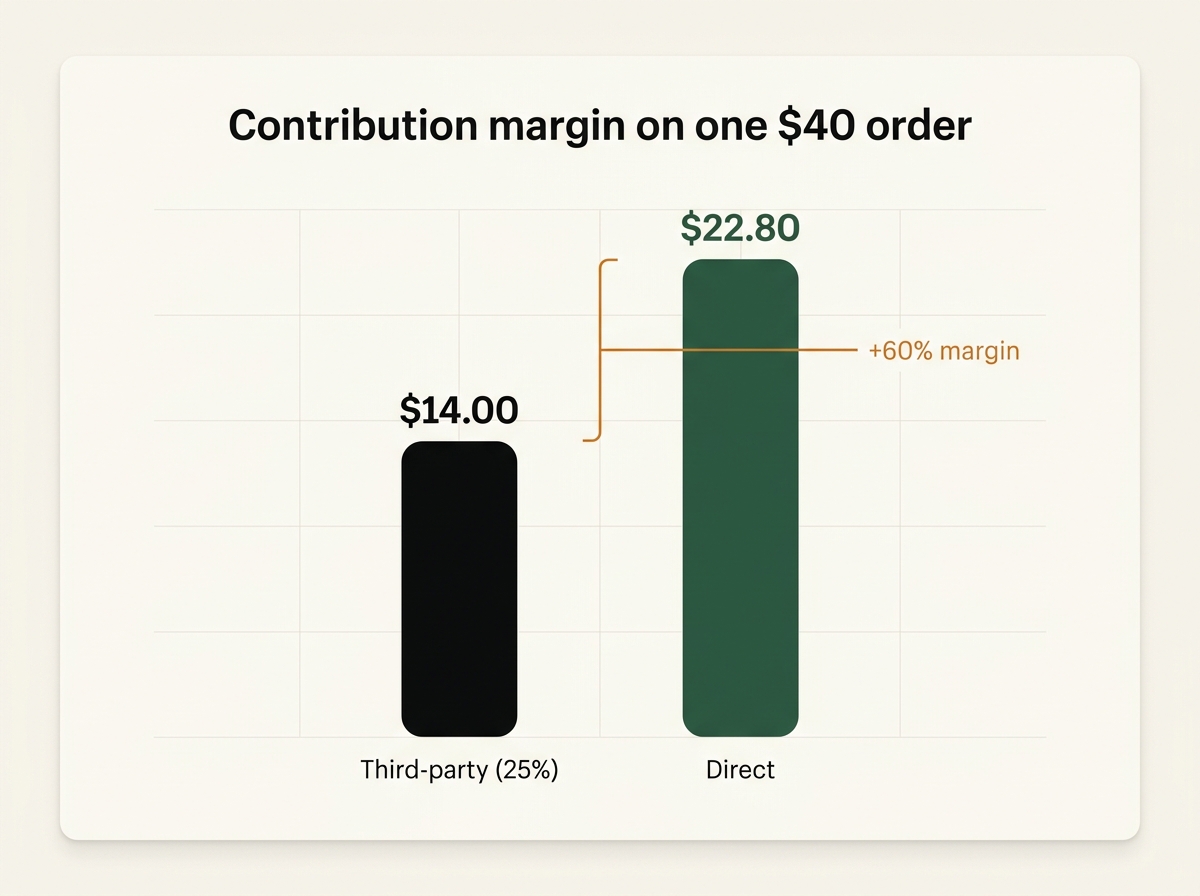
Here's a $40 order, side by side:
| Third-party (25% tier) | First-party (direct) | |
|---|---|---|
| Order subtotal | $40.00 | $40.00 |
| Commission | −$10.00 | $0.00 |
| Card processing (~3%) | included above | −$1.20 |
| You receive | $30.00 | $38.80 |
| Food cost (~30%) | −$12.00 | −$12.00 |
| Packaging & labor (est.) | −$4.00 | −$4.00 |
| Contribution margin | $14.00 | $22.80 |
The direct order contributes roughly 60% more margin. Across 300 orders a month, that's about $2,600/month (over $31,000 a year) from routing the same demand down a different road.
(The flat platform cost barely dents this: Menuline's Growth plan is $99/month total, with 0% commission on every plan.)
Run your own numbers: the free delivery app fee calculator shows what marketplace commissions cost you per month and year next to commission-free direct ordering — just enter your orders, average ticket, and tier.
Doesn't first-party mean I have to do my own delivery?
Not necessarily, and this is where the first-party/third-party framing gets oversimplified.
- Pickup orders need no drivers at all, and pickup is a large share of direct volume for most independents.
- Self-delivery works if you have staff and a defined radius.
- Hybrid models exist too: some restaurants keep a marketplace purely for delivery logistics while pushing pickup and repeat orders direct.
The margin comparison above is really about who owns the order, not who drives the car.
What do you give up by going direct?
Honesty section. Third-party marketplaces provide two things your website cannot, especially early on:
1. Discovery. Marketplaces are where undecided hungry people browse. A new or unknown restaurant gets put in front of customers it had no other way to reach. That's real, and it's what the commission actually buys.
2. Built-in demand on day one. Your own site starts with your existing audience. If you don't have one yet, marketplaces generate trial while you build it.
This is why the answer to "first-party or third-party?" is usually both, with a deliberate funnel between them.
What is the funnel-to-direct strategy?
Treat third-party as your paid acquisition channel and first-party as your retention channel:
- Stay listed on a marketplace (often at a lower tier) so new customers can discover you. Accept the commission as marketing spend, on first orders.
- Convert every marketplace customer you can. QR-code inserts in every bag, a "skip the menu markups, order direct" offer, loyalty points that only accrue on direct orders.
- Win your branded search. Make sure Googling your restaurant's name leads to your ordering page, via your website and your Google Business Profile ordering link, not a marketplace listing.
- Retain with marketing you own. Email/SMS follow-ups and rewards bring customers back direct. This is impossible on marketplaces, because they keep the customer data.
Done consistently, the mix shifts: marketplaces keep doing the job they're good at (finding strangers) and stop doing the job they're terrible at (serving regulars at a 25% toll).
What does the blended picture look like?
A restaurant doing $15,000/month online, at a 25% marketplace tier:
| Mix | Marketplace fees | Direct costs (Menuline Growth + ~3% processing) | Total channel cost |
|---|---|---|---|
| 100% third-party | $3,750 | n/a | $3,750/mo |
| 60/40 direct | $1,500 | $369 | $1,869/mo |
| 80/20 direct | $750 | $459 | $1,209/mo |
Even a partial shift funds itself many times over, and unlike commission, the flat cost doesn't grow as your volume does.
So which makes restaurants more money?
Per order, first-party wins, decisively and structurally, because 0% beats 15–30% every time. Per strategy, the winner is the funnel: third-party for discovering customers, first-party for keeping them.
Menuline is built for the first-party side of that funnel: an AI-built website, commission-free ordering on every plan, a branded mobile app, and AI marketing that brings customers back, all from $29/month ($1/month for your first 3 months, no long-term contracts). See pricing, or run the free AI grader to see how much of your demand you could be capturing direct today.