"You need an app" is advice restaurants hear constantly, usually from someone selling apps. The honest answer is more useful: some restaurants genuinely benefit from a branded app, many don't need one, and which group you're in depends mostly on repeat-order volume.
Here's how to tell, without the sales pitch.
What does a mobile app actually do that a website can't?
Be clear-eyed about the real differences. A well-built mobile ordering website already handles browsing, ordering, and payment on a phone. What an app adds:
- A permanent icon on the home screen. Your restaurant sits next to the customer's messaging apps, a standing visual reminder that shortcuts the "what should we eat?" decision.
- Faster repeat orders. Saved details, order history, one-tap reordering. The tenth order takes seconds.
- Push notifications. A direct line for order updates, loyalty milestones, and time-sensitive offers. No algorithm, no inbox competition. Used sparingly, it's the highest-attention channel you can own.
- A home for loyalty. Points visibly accumulating in an app make the loyalty loop feel tangible in a way a website session doesn't.
What an app does not do: bring in new customers. Nobody discovers a restaurant by browsing the App Store. Discovery lives on Google and AI search, and that's your website's job (see the restaurant SEO guide).
When does a branded app pay off?
The pattern is simple: apps reward frequency. Every benefit above compounds with repeat use and is wasted on someone who orders once a year.
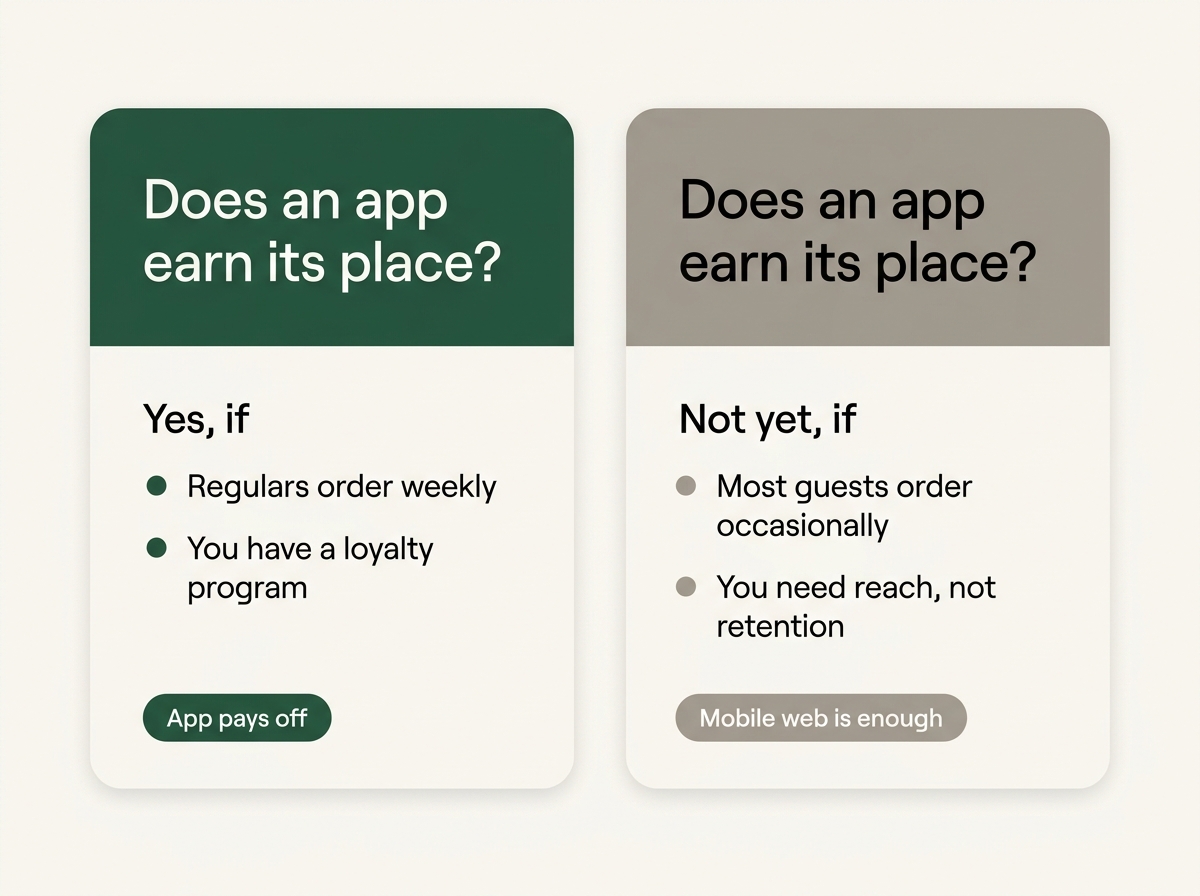
An app is likely worth it if:
- You have real repeat-order volume: a base of customers ordering weekly or several times a month, like the lunch spot near offices, the pizza place with a Friday-night following, the bubble tea shop with daily regulars
- Speed of reorder matters: your regulars order the same things and would feel the difference between five taps and twenty
- You're running loyalty and want it somewhere customers actually check
- You want a direct channel for pushes about specials and rewards
An app is probably premature if:
- Most customers are first-time or occasional: a destination or special-occasion restaurant where the same person orders a few times a year
- Your mobile website is still weak: fix the experience every customer touches before adding a channel for your best ones
- You have no reorder engine yet: no follow-ups, no loyalty, no reason for a second order; an empty app doesn't create demand (start here instead)
One nuance: "no" is often "not yet." Build the repeat-customer base with a great site, follow-ups, and loyalty, then give those regulars an app to live in.
Branded app vs marketplace apps: aren't you already "in an app"?
Being listed in DoorDash's app is not having an app. The differences decide who profits from your regulars:
| Marketplace app (DoorDash, Uber Eats) | Your branded app | |
|---|---|---|
| Whose brand | Theirs (you're a listing) | Yours (your name and icon) |
| Competition | Competitors one scroll away | None |
| Commission | Per-order fees on every order | Direct orders, no marketplace commission |
| Customer data | The marketplace keeps it | Yours |
| Loyalty and pushes | Promotes the marketplace | Promotes you |
Marketplaces are a discovery channel; some restaurants sensibly keep them for reaching strangers. But routing your regulars, people who would happily order direct, through a commission-charging intermediary is paying an acquisition fee for customers you already own. The full economics are in third-party delivery vs direct ordering. A branded app is the strongest tool for moving regulars to the direct channel, because it's more convenient than the marketplace, not just cheaper for you.
What about the cost of building one?
The traditional objection was decisive: custom iOS and Android development, app store maintenance, and updates put branded apps out of reach for independents. Apps were a chains-only game.
Platforms changed the arithmetic. Menuline's Growth plan ($99/month) includes a branded iOS and Android app: published under your restaurant's own name, connected to the same commission-free ordering, loyalty, and AI marketing as your website, with plans starting at $29/month, $1/month for the first 3 months. When the app is bundled rather than a six-figure project, the question stops being "can we afford an app?" and becomes the right question: "do our customers order often enough to use one?"
How do you decide?
- Estimate your repeat share. Roughly what fraction of orders come from people who order at least monthly? A meaningful regulars base is the green light.
- Grade your mobile website first. If ordering on your site is slow or clunky, fix that for everyone before layering an app. The free Menuline AI grader shows where you stand in about a minute.
- Build the reorder engine. Follow-ups and loyalty create the frequent customers an app serves.
- Then launch the app for your regulars, and promote it where they already are: order confirmations, receipts, follow-up texts.
The honest bottom line: your website wins new customers; an app deepens the relationship with regulars. Not every restaurant needs the second piece today, but if you have regulars, giving them a faster way to come back is one of the cheapest wins available, especially when the app is included rather than a project. Start for free to see how the site, app, and ordering fit together.