On October 29, 2026, the Federal Trade Commission, the attorneys general of seven states, and Los Angeles County and San Francisco sued Toast in federal court. The complaint alleges hidden fees, add-ons charged without consent, 24/7 support that wasn't, and a cancellation process built to be hard to finish. These are allegations, not findings: the case is pending and Toast says it will fight it. If you run Toast, the useful move today is to read your own contract and invoice against the specific practices the complaint describes.
Below: what is actually alleged (with the dollar figures from the FTC's own announcement), what Toast said back, and a short checklist for owners.
Disclosure: Menuline sells restaurant websites and online ordering, and it does not replace a POS. We link to every primary source so you can read them yourself.
What happened on October 29, 2026?
The FTC filed a complaint in the U.S. District Court for the Northern District of California, after a 2-0 Commission vote, per the FTC's case page. The plaintiffs:
| Plaintiff | Who |
|---|---|
| Federal | Federal Trade Commission |
| States | Colorado, Florida, Illinois, Iowa, Nebraska, Oklahoma, Utah |
| California | The People of California, through Los Angeles County Counsel and the San Francisco City Attorney |
The defendants are Toast, Inc. and five affiliates, including Toast Capital LLC (its lending arm), Toast Processing Services, and xtraCHEF. The legal claims cite the FTC Act, the Restore Online Shoppers' Confidence Act (ROSCA, the federal law on subscriptions and cancellation), and state consumer-protection laws.
Toast says close to 200,000 business locations use its platform, so a lot of restaurants are reading the same headlines this week.
What does the FTC allege about Toast's fees?
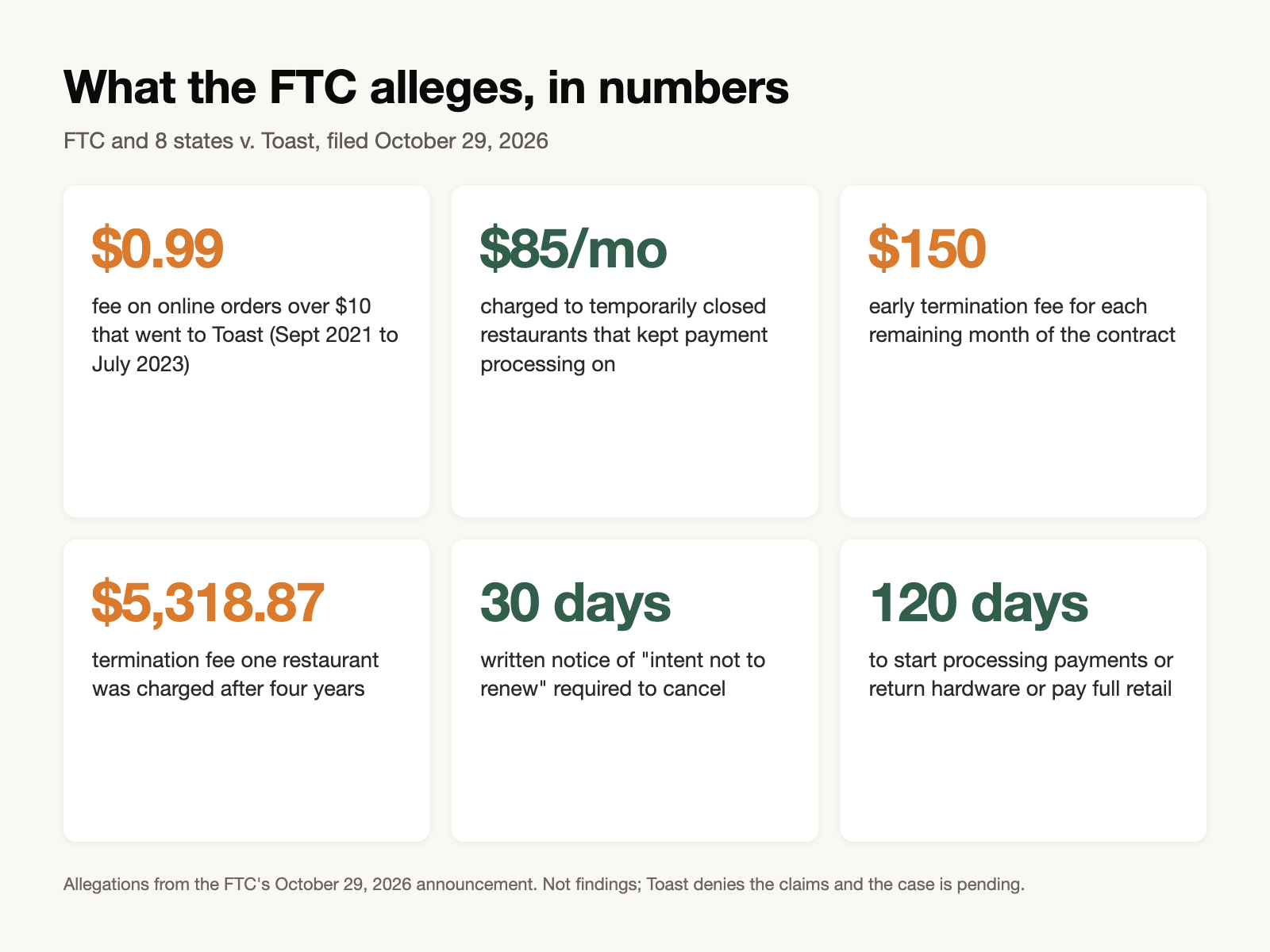
Per the FTC press release, the complaint describes these specific practices:
| Alleged practice | What the complaint describes |
|---|---|
| "$0 per month" plan | Restaurants on the pay-as-you-go plan were told hardware and software cost $0/month in exchange for higher processing rates, then allegedly hit with undisclosed fees |
| Diner fee on online orders | A $0.99 fee on online orders over $10, from September 2021 to July 2023, that went to Toast, not the restaurant |
| Temporarily closed | $85/month for restaurants that closed temporarily but kept payment processing on |
| Early termination | $150 for each remaining month of the contract, which the complaint says wasn't disclosed; one customer was charged $5,318.87 after four years |
| Unused hardware | Restaurants that didn't process payments within 120 days had to return hardware or pay full retail value |
| Add-ons | Restaurants allegedly enrolled in and billed for employee timekeeping, payroll processing and payroll tax filing without consent |
The FTC also puts the typical Toast subscription at about $900/month, depending on terminals and add-ons. That number is much higher than the software tiers on Toast's pricing page, which is the gap our Toast pricing breakdown walks through line by line.
What does the complaint say about cancelling and support?
Two more groups of allegations matter to anyone thinking about leaving:
- Cancelling. The complaint says restaurants had to give 30 days' written notice of "intent not to renew", which wasn't clearly disclosed, then work through a multi-step process across several Toast teams, with sales pitches along the way.
- Loans. For restaurants with a Toast Capital loan, the complaint says cancelling the subscription could put the loan in default and make the full balance due immediately.
- Support. Toast advertised "24/7/365 support" from people who "really get restaurants." The complaint cites owners who couldn't reach help, including one who called on a Saturday and learned his support team didn't work weekends, and fixes that took weeks or months.
FTC Bureau of Consumer Protection Director Christopher Mufarrige summed up the agency's position: "Toast failed to honor a number of its promises and instead imposed hidden fees."
What did Toast say?
Toast rejects the case. Per its statement reported by Nation's Restaurant News and others, Toast said it "strongly disagree[s] with the allegations" and "will vigorously defend the Company," that "the FTC disregarded the information we provided showing the extent to which our restaurant customers negotiate their contracts," and that "nothing about today's news changes our customer service, pricing, or support." Toast also said it had cooperated with the FTC's review since mid-2025, including efforts to settle without a lawsuit.
The FTC's own page makes the same point from the other side: a complaint means the agency has "reason to believe" the law was broken. It is not a finding of wrongdoing, and a court will decide.
I'm on Toast. What should I check this week?
You don't need a lawyer to do a first pass. Pull your order form or contract and your last three invoices and check:
- Renewal date and notice window. When does your term renew, and how many days before that must you send notice not to renew? Put the deadline in your calendar now.
- Early termination fee formula. Is it a flat amount or a per-remaining-month charge? Multiply it out so you know your real exit cost today.
- Every recurring line item. Match each subscription on the invoice to something you actually asked for. Payroll, timekeeping and payroll tax filing are the add-ons the complaint names.
- Processing and "$0" plans. If you're on pay-as-you-go, compare your effective processing rate (total fees divided by card volume) to what you were quoted.
- Loans. If you took Toast Capital financing, read what happens to the loan if the subscription ends.
- Online ordering fees. Check what diners pay on your Toast online orders today and what you pay per order.
If something doesn't match what you were sold, ask your Toast rep in writing and keep the reply. The FTC also takes reports at ReportFraud.ftc.gov.
Should I switch off Toast?
Probably not because of a lawsuit alone. Toast is a deep POS: kitchen display, handhelds, payroll, inventory. Ripping it out mid-service season has real costs, and your contract may make leaving expensive. The case could take a long time to resolve.
What the case does change is leverage and attention. It's a good moment to:
- Renegotiate. Toast says restaurants negotiate their contracts. Ask for add-ons you don't use to be removed and for termination terms in writing.
- Separate the pieces. Your POS doesn't have to be your website, online ordering, loyalty and email tool. Those can sit on a separate platform you can leave month to month, so one vendor doesn't hold your whole digital business.
When Toast is still the right choice: you're a full-service or high-volume restaurant that uses its kitchen display, handhelds and payroll every day, your contract terms are clear, and you've checked the invoice against what you agreed to.
Can I take online orders without switching my POS?
Yes. Online ordering doesn't have to come from your POS company. Options include your POS's own module, a standalone ordering platform, or third-party apps (which charge restaurants 15 to 30% commission per order, per their published partner plans; see our DoorDash commission breakdown).
On Menuline, a restaurant website with commission-free online ordering and loyalty is $29/month (Starter), and $99/month (Growth) adds AI-powered email marketing and a branded app; both are $1/month for the first 3 months, month-to-month with no contract and no hardware. Restaurants pay 0% commission; diners pay a 5% platform fee at checkout, so if a diner-side fee matters to you, that part is not free on any of these platforms. The honest trade-off for Toast restaurants: Menuline orders arrive in the Menuline dashboard and print on a Star cloud printer, and they can be sent to Square or Clover, not into Toast.
If you want to see where your restaurant stands online before deciding anything, the free Menuline grader checks your Google profile, website and ordering setup in about a minute.
The bottom line
The FTC and eight states are alleging that Toast's $0 plan wasn't $0, that add-ons were billed without consent, that a $0.99 diner fee went to Toast, and that leaving cost restaurants up to $150 per remaining month. Toast denies all of it and the court will decide. Whatever the outcome, every Toast restaurant should spend 20 minutes this week with its contract and invoices: know your renewal date, your exit cost and every line you're paying for. Then decide, calmly, which parts of your tech you want locked to one vendor.
Sources: FTC case page, FTC press release, Nation's Restaurant News, Payments Dive. Allegations as described by the FTC on October 29, 2026; not findings of fact.