
Comparing Menuline and Toast is a bit like comparing a storefront to a kitchen: they're different layers of the same business. Toast is first and foremost a point-of-sale system: terminals, kitchen displays, payroll, payments. Menuline is the customer-facing layer: your website, commission-free online ordering, branded mobile app, and the marketing that brings customers back.
That said, restaurants compare them constantly, because Toast sells online ordering as an add-on and many owners wonder whether that's enough. Here's an honest breakdown.
What is each platform actually for?
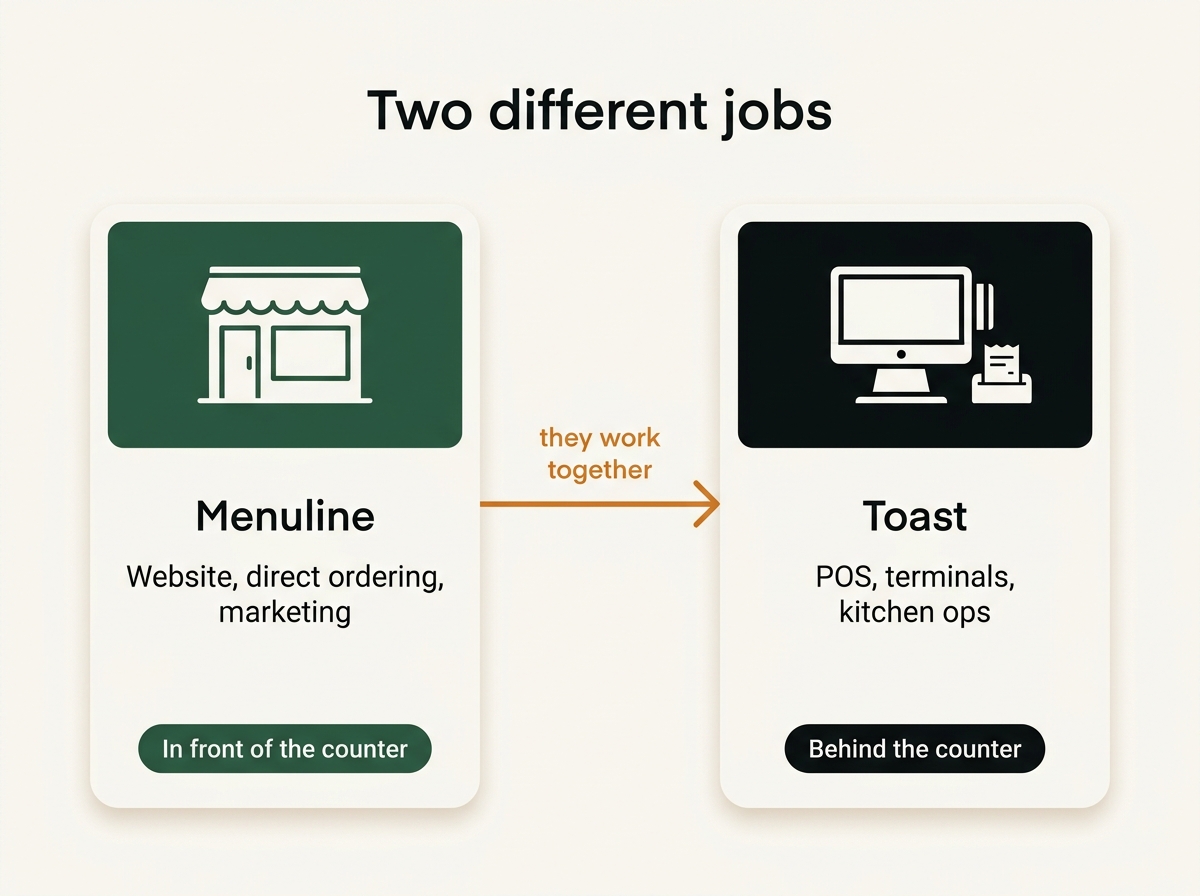
Toast runs your restaurant's operations: order entry, payments, kitchen routing, staff management. Its online ordering add-on gives you a Toast-hosted ordering page that flows straight into your POS.
Menuline runs your restaurant's online presence: an AI-built, SEO-optimized website, commission-free direct ordering, a branded iOS and Android app under your restaurant's name, and AI-powered marketing, loyalty, and follow-ups. Menuline is not a POS and doesn't try to be one; it works alongside whatever POS you already use, Toast included.
Menuline vs Toast at a glance
| Menuline | Toast | |
|---|---|---|
| Category | Website, ordering & marketing platform | Point-of-sale system |
| Published entry price | $29/month ($1/mo first 3 months) | $0/month Starter Kit (higher processing); paid plans from $69/month |
| Online ordering | Included, 0% commission every plan | Paid add-on |
| Restaurant website | Yes, AI-built, SEO-optimized | Ordering page, not a marketing site |
| Branded mobile app | Yes, iOS and Android | Via Toast's ecosystem |
| Marketing & loyalty automation | Yes, AI follow-ups and rewards | Available as paid add-ons |
| In-restaurant POS, KDS, payroll | No | Yes, core product |
| Contracts | No long-term contracts | Varies by package |
Toast pricing per Toast's published pricing as of 2026; add-on and processing costs vary by package, so confirm with Toast directly.
How much does each cost in practice?
Per Toast's published pricing as of 2026, the Starter Kit is $0/month with no upfront hardware cost (the tradeoff is higher payment processing rates), and paid POS plans start around $69/month. Online ordering, marketing, and loyalty are each paid add-ons, so a Toast setup with digital ordering and marketing typically lands well above the headline number once add-ons stack up.
Menuline's pricing is simpler: Starter at $29/month, Growth at $99/month, both $1/month for the first 3 months, and 0% commission on direct orders on every plan. Website, ordering, branded app, and marketing automation are all part of the platform, not separate line items.
Where Toast is genuinely better
Honesty first: if you need a POS, Menuline isn't in the running, and Toast is one of the most widely used restaurant POS systems for good reason.
- Operations are the core product. Terminals, handhelds, kitchen display screens, payroll, and payments are all deeply integrated.
- Ordering flows straight into the POS. Toast's online orders land in the same system your kitchen already uses, with no integration work.
- One vendor for everything operational. For owners who want a single throat to choke, that matters.
If your main problem is in-restaurant operations, evaluate Toast (and its POS competitors) on those merits.
Where Menuline is better
If your main problem is getting more direct online orders, the comparison flips:
- A real website, not an ordering page. Toast's add-on gives you a hosted ordering flow. Menuline builds and continuously optimizes a full SEO-oriented website designed to rank on Google and convert visitors, the thing that actually brings in new customers.
- A branded app included. Menuline publishes an iOS and Android app under your restaurant's own brand on the Growth plan.
- Marketing built in, not bolted on. AI-driven follow-ups, loyalty, and rewards are part of the platform rather than a stack of separately priced modules.
- Flat, low pricing. $29–$99/month with 0% commission, versus an add-on economy where each capability is its own fee.
Can you use both together?
Yes, and this is the arrangement that makes the most sense for many restaurants: Toast (or any POS) handles in-restaurant operations, while Menuline handles the website, direct ordering, branded app, and repeat-customer marketing. They're complementary layers, not head-to-head substitutes.
For restaurants specifically unhappy with Toast's digital ordering experience or add-on costs, see the best Toast alternatives for online ordering and websites.
How to decide
- Name the problem. Aging POS hardware and kitchen chaos → that's a POS decision. Weak website, few direct orders, no repeat-visit engine → that's the layer Menuline covers.
- Price the full stack. Get Toast's quote including the ordering and marketing add-ons you'd actually use, then compare it to $29–$99/month flat.
- Audit your online presence. Run the free Menuline AI grader; it scores your website, Google presence, and ordering setup in about a minute.
The bottom line
Toast is a strong POS; Menuline is the website, ordering, and marketing layer that sits in front of any POS. If you're choosing a POS, look at Toast. If you're trying to grow direct online orders without commissions or add-on sprawl, Menuline does that job for $29–$99/month, and works fine right alongside your Toast terminals.