Two restaurants can serve the same food at the same prices and make very different money, purely because of what their menus steer people toward. Menu engineering is the craft of doing that steering deliberately: you learn which items earn, then design the menu so more orders land on them.
Here's the classic framework and how to apply it, on paper and online.
What is the menu engineering matrix?
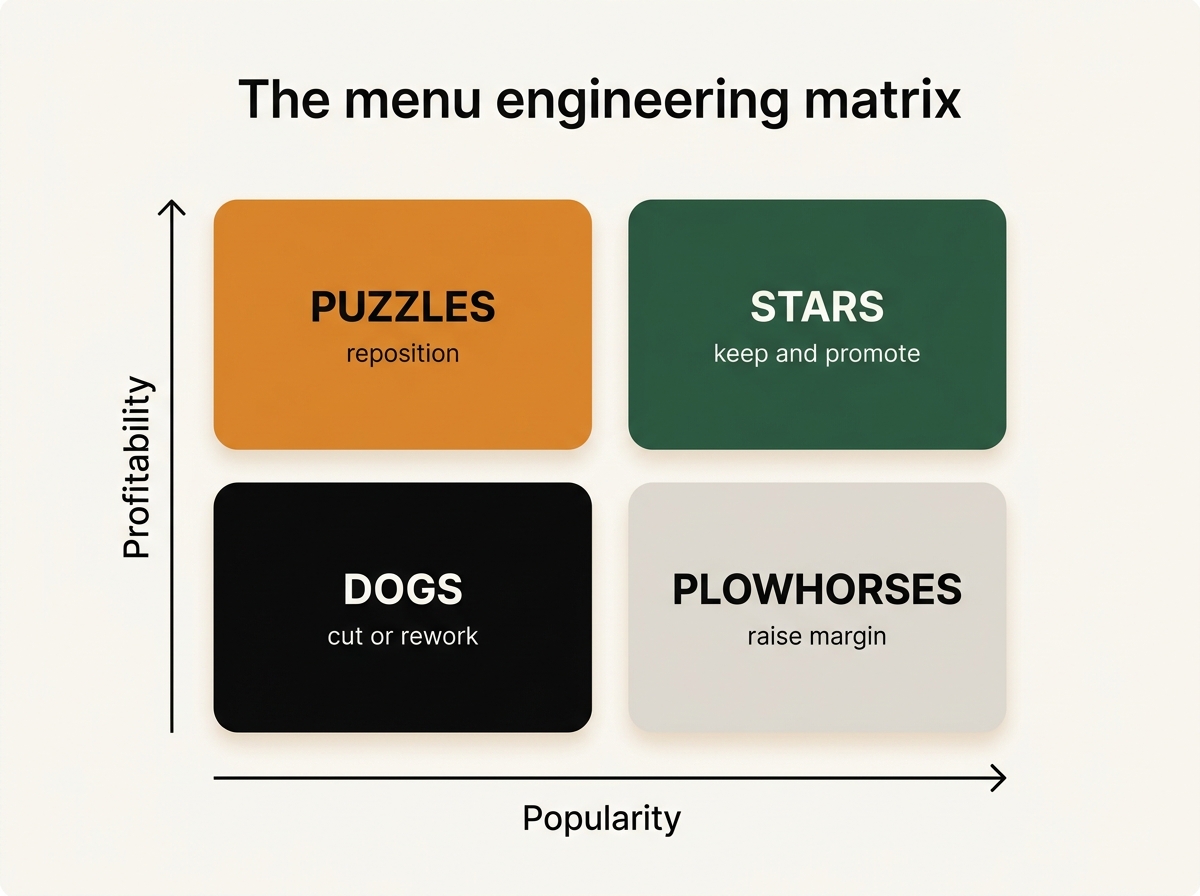
The classic hospitality framework scores every item on two axes:
- Popularity: how often it's ordered relative to other items
- Profitability: contribution margin, meaning selling price minus what the plate costs you to produce (dollars left over, not margin percentage)
That yields four quadrants:
| High popularity | Low popularity | |
|---|---|---|
| High profit | Stars | Puzzles |
| Low profit | Plowhorses | Dogs |
The labels matter less than the fact that each quadrant has a distinct playbook.
Stars: protect and feature
Popular and profitable. Give them the best menu real estate, photos online, and a place in your marketing. Guard their quality; these dishes are your reputation.
Plowhorses: popular but thin margins
People love them, but each order earns little. Options: re-cost the recipe (portion or ingredient tweaks that preserve the experience), pair them with high-margin add-ons, or nudge the price gently. Move carefully, because plowhorses are often why people come.
Puzzles: profitable but overlooked
The margin is great; nobody orders them. Usually a presentation problem: a bland name, a buried position, no description. Rename evocatively, add a compelling description, feature them, or have servers recommend them. If promotion fails, the dish may just not fit your concept.
Dogs: neither
Low interest, low margin. Retire them, or rework them into something with a reason to exist. Every dog on the menu adds inventory, prep complexity, and choice paralysis while earning almost nothing.
Do the math with your own numbers. A spreadsheet of items, order counts, and plate costs is all it takes. The framework only works when fed real data, so resist the urge to sort by gut feel.
Skip the spreadsheet: the free menu engineering calculator sorts your items into Stars, Plowhorses, Puzzles, and Dogs from sales, price, and cost — and the food cost calculator gets you the plate costs first.
How does pricing psychology work on menus?
A few techniques are commonly used across the industry. None of it is magic, just how people read prices:
- Charm pricing. Ending at .95 or .99 makes a price feel smaller; it also signals value-orientation. Fast-casual concepts use it heavily; upscale menus often prefer clean whole numbers ("18") without currency signs, which reads as confident rather than transactional. Match the technique to your positioning.
- Anchoring. A premium item at the top of a section makes everything below feel reasonably priced. The lobster platter doesn't need to sell often to earn its place. It recalibrates what "expensive" means on your menu.
- Avoid price columns. A neat right-aligned column of prices with dotted leader lines invites shopping by price. Placing each price at the end of the description, in the same type size, keeps attention on the food.
- Descriptions sell. "Slow-braised short rib, red wine jus, charred scallions" outsells "Beef short rib" because specificity signals care. Use it deliberately on stars and puzzles.
These are nudges, not tricks; they don't rescue a dish nobody wants.
How does layout steer what people order?
On a physical menu:
- Eyes land first on prominent positions: the top of sections and visually distinct areas. Put stars and puzzles there.
- Boxes, icons, and "chef's favorite" callouts reliably draw orders toward whatever they mark. Mark high-margin items, not whatever needed using up.
- Shorter menus sell better than encyclopedias. Fewer, better choices reduce decision fatigue, simplify your kitchen, and make each remaining item easier to feature.
What changes when the menu is online?
Everything above applies online, with better tools:
- You control the default sort. The first items in each category online are your prime real estate. Most ordering systems let you order items manually: put stars first.
- Photos are selective weapons. Online, a great photo next to a high-margin dish is a feature flag; a photo next to every item is noise. Feature deliberately.
- Modifiers are margin. Add-ons, sides, upsizes presented at the right moment ("add guac?") raise average order value one small yes at a time.
- You get real data. An online menu tells you exactly what's viewed and ordered, so the popularity axis of your matrix updates itself. Recheck quarterly and after menu changes.
- The menu must be crawlable. Online, your menu is also a marketing asset: real HTML text that Google and AI assistants can read is how dish-level searches find you. That's covered in the restaurant SEO guide.
A menu engineered for margin but published as a PDF forfeits the discovery half of its job.
Menu engineering checklist
- Compute contribution margin and order share for every item
- Sort into stars, plowhorses, puzzles, dogs
- Feature stars; rename and describe puzzles; re-cost plowhorses; cut dogs
- Choose a pricing style that fits your concept; add an anchor item per section
- End descriptions with prices, no price columns
- Online: stars first in each category, photos on featured items, add-ons in the flow
- Publish the menu as crawlable HTML, not a PDF
- Revisit the matrix quarterly with fresh numbers
An engineered menu deserves an ordering channel that keeps the margin you just built. Menuline pairs a fast, crawlable online menu with commission-free direct ordering from $29/month, and the free AI grader will show you in about a minute how your current menu and site stack up. For the demand side of the equation, see how to get more online orders.