
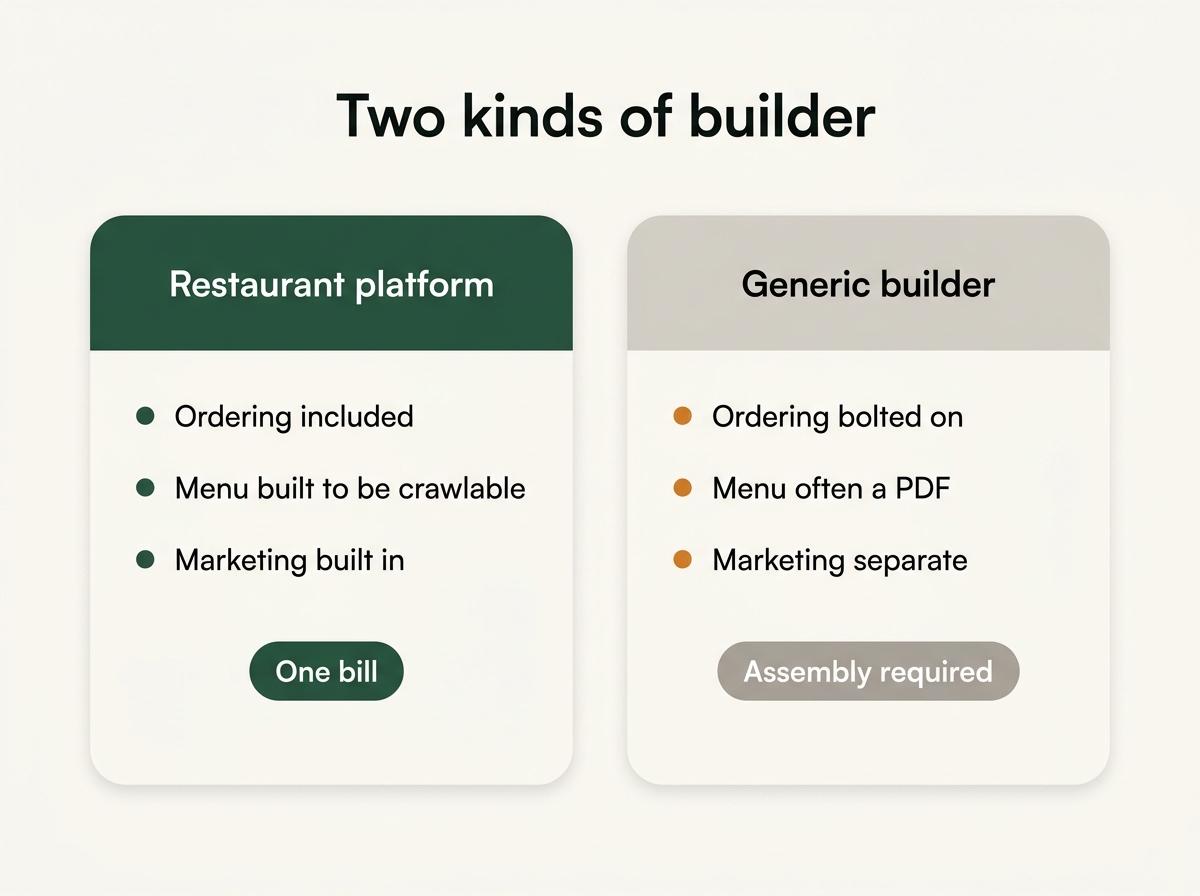
A restaurant website has one job that a normal business website doesn't: turn a hungry visitor into an order in under two minutes. That single difference is why this list splits into two camps: restaurant-specific platforms that build ordering in, and generic builders that bolt it on. Here's our 2026 ranking, with the disclosure up front that Menuline is our platform, and the reasoning laid out so you can judge it.
What makes a restaurant website builder "best"?
Four tests worth applying to anything on this list:
- Can customers order directly on the site, commission-free?
- Will it rank? Local SEO, menu schema, fast load times. The things that win "best tacos near me."
- Does it drive repeat business? Email/SMS marketing and loyalty built in, or bring-your-own.
- What does it cost at your size? Both the sticker price and the add-ons.
1. Menuline: best overall
Pricing: $29/month (Starter) or $99/month (Growth); $1/month for the first 3 months; no long-term contracts.
Menuline is restaurant-specific from the ground up: an AI-built, SEO-optimized website generated from your existing menu and Google Business Profile, with commission-free online ordering (0% on every plan), a branded iOS and Android app, and AI-powered marketing, loyalty, and rewards included, not sold as add-ons.
The honest pitch for #1: it passes all four tests above at a price below most generic builders' business tiers, and setup takes minutes rather than an agency engagement. The honest caveats: it's newer than Popmenu or BentoBox, and if you want deeply bespoke agency design, a template-driven platform of any kind may feel constraining. See pricing.
2. Popmenu: strong marketing features at a higher price
Reported pricing: plans from roughly $179 to $499/month, with online ordering as an additional add-on (Popmenu's exact pricing is quoted by sales).
Popmenu built its reputation on interactive menus, dish photos, reviews, and ratings embedded right in the menu, plus solid marketing tools (email, SMS, review management) and an AI phone answering add-on. It's a genuinely good marketing platform. The concern is cost stacking: per its published pricing as of 2026, base plans run $179–$299/month with online ordering an extra-cost add-on, which lands the real bill at several times Menuline's Growth plan. Compare directly in Menuline vs Popmenu or see Popmenu alternatives.
3. BentoBox: design-forward, hospitality-focused
Reported pricing: website plans from roughly $119 to $479/month, with takeout/delivery ordering as a ~$49/month add-on plus per-order fees, per third-party breakdowns (quote-based).
BentoBox powers many upscale and hospitality-group websites, and it shows: the design quality is high, and it handles events, catering, and private dining well. For white-tablecloth brands where the website is a design statement, it's a fair choice. For independents focused on order volume, the economics work against it: ordering is an add-on with reported per-order fees, and the total cost runs well past the flat-fee alternatives. See Menuline vs BentoBox and BentoBox alternatives.
4. Squarespace: best generic builder for looks
Published pricing: roughly $16–$49/month depending on tier, per Squarespace's published pricing as of 2026.
Squarespace makes beautiful websites cheaply, and for a bar or fine-dining room that takes no online orders, it can be enough. The restaurant-shaped holes: no native restaurant ordering (you'll embed a third-party widget or link out, often to commission-charging platforms), menu updates are manual page edits, and there's no restaurant-specific SEO or marketing. You save money on the website and leak it through the ordering experience.
5. Wix: cheapest full-featured generic builder
Published pricing: roughly $17–$159/month across tiers, per Wix's published pricing as of 2026.
Wix offers a restaurant-menu app ecosystem and flexible templates at low cost, making it the tinkerer's choice. Same structural problem as Squarespace: ordering, loyalty, and local SEO are assembled from plugins rather than built in, and the result rarely converts like a purpose-built restaurant platform. Fine for a placeholder site; limiting as a revenue channel.
Comparison at a glance
| Builder | Typical monthly cost | Ordering built in? | Branded app | Restaurant SEO/marketing |
|---|---|---|---|---|
| Menuline | $29–$99 flat | Yes, 0% commission | iOS + Android | AI-powered, included |
| Popmenu | ~$179–$499 + ordering add-on (reported) | Add-on | Higher tiers | Yes |
| BentoBox | ~$119–$479 + ordering add-on (reported) | Add-on w/ per-order fees | Limited | Some tiers |
| Squarespace | $16–$49 (published) | No, third-party embeds | No | Generic only |
| Wix | $17–$159 (published) | Via plugins | No | Generic only |
Popmenu and BentoBox figures are from third-party breakdowns as of 2026; both platforms quote pricing via sales. Verify current numbers directly.
Generic builder vs restaurant platform: the real decision
The $16–$50/month generic builders aren't bad products. They're the wrong product for a restaurant that takes orders. The moment your website's job includes "sell food," every gap (ordering widgets, manual menus, no loyalty, no local SEO) either costs you conversions or pushes customers to 15–30%-commission marketplaces.
The full cost picture (DIY builders vs agencies vs restaurant platforms) is in our guide to how much a restaurant website costs.
The bottom line
If your website needs to sell food, pick a restaurant platform, and Menuline gives you the complete stack (site, 0% ordering, branded app, AI marketing) for $29–$99/month, less than the add-ons alone on the legacy platforms. Want to see how your current website stacks up first? Run the free Menuline AI grader. It takes about a minute.