
A growing share of "where should we eat?" decisions now start in a chat box. People ask ChatGPT for date-night ideas, ask Perplexity for the best ramen nearby, and read Google's AI-generated answers above the traditional results. When an assistant answers, it names a handful of restaurants, and either you're in that answer or you don't exist.
The good news: how assistants choose is not a mystery, and most of what influences them is under your control.
Where do AI assistants get their restaurant information?
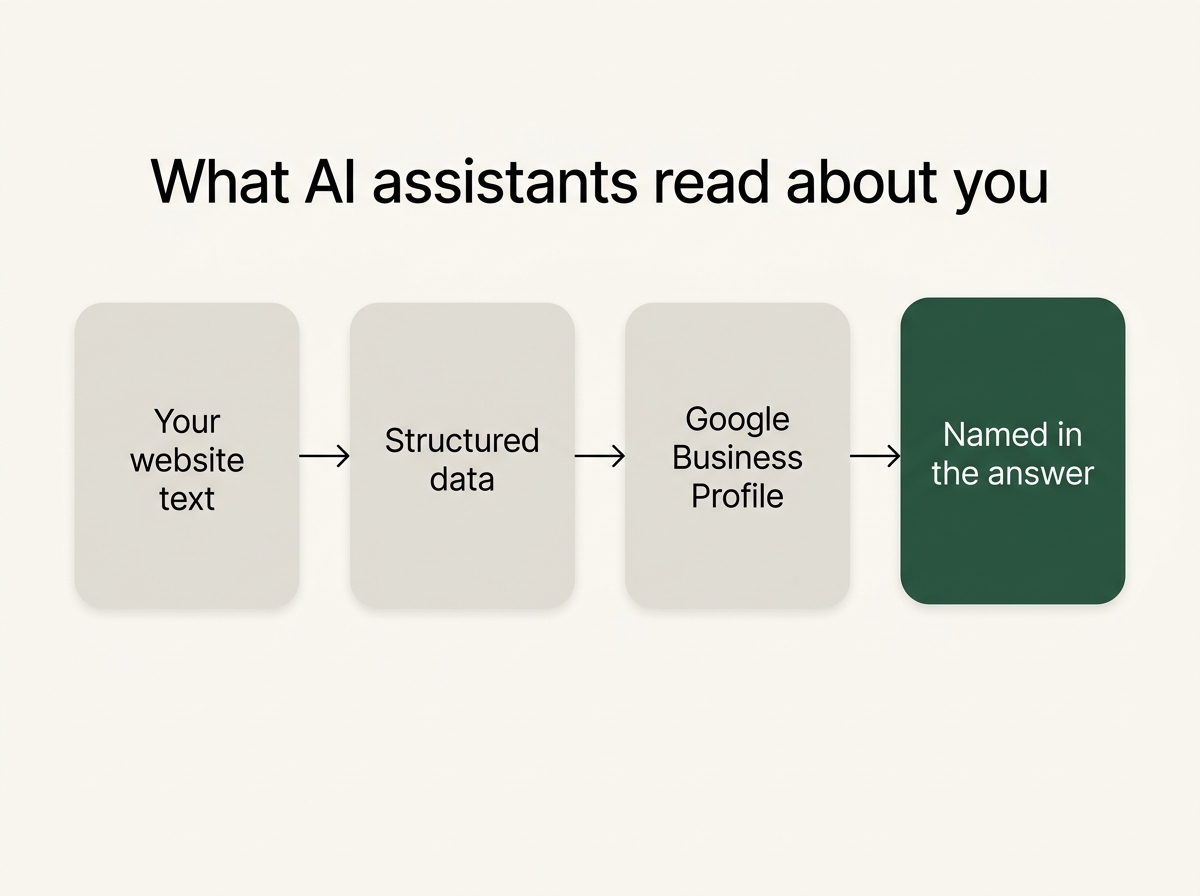
AI assistants don't have opinions about your food. They assemble answers from what's publicly readable about you:
- Google Business Profile data: categories, attributes, hours, price range. When someone asks for "a vegan-friendly place with outdoor seating," the assistant's answer often maps directly onto listing attributes.
- Reviews: not just star ratings, but the text. If dozens of reviews mention your birria tacos, an assistant asked about birria tacos has strong evidence to name you.
- Your website: read the way a crawler reads it, as text and structure. Real HTML gets understood; PDFs and image-based menus largely don't.
- Structured data: schema markup that states machine-readably what you are, what you serve, and when you're open.
- Live web search: many assistants search in real time and read the results, which means normal search visibility feeds AI visibility directly.
Notice the overlap with ordinary restaurant SEO. AI search is the same game with stricter grading, not a separate one.
Why do PDF menus fail harder in AI search?
Traditional SEO merely penalized hard-to-crawl content. AI assistants effectively require readable content, because they compose answers out of text they can parse.
Consider what happens when someone asks an assistant, "who has good lamb shawarma near me that's open now?" To include you, the system needs to read, somewhere, that you serve lamb shawarma and what your hours are. If your menu is a PDF scan and your hours live only in an Instagram highlight, there is nothing for the machine to work with, no matter how good the shawarma is.
Rules of thumb:
- Every dish should exist as real HTML text on your site: name, description, price
- Hours, address, and phone should be consistent across your site and Google listing
- Anything you'd want an AI to say about you should be written somewhere it can read
What is llms.txt and should your restaurant site have one?
llms.txt is an emerging convention for the AI era: a plain-text file at your site's root that gives AI systems a concise summary of who you are and structured links to your key pages, often paired with markdown versions of those pages that are trivial for machines to parse.
Think of it as robots.txt's helpful younger sibling: instead of telling crawlers what to avoid, it hands them a map of what matters. It's early and not every AI system reads it yet, but it costs almost nothing to publish and is a clear, forward-compatible signal.
This isn't theoretical advice from the sidelines: menuline.ai itself publishes an llms.txt file and markdown versions of its pages for AI crawlers, and Menuline builds restaurant sites with the same machine-readable plumbing.
How do reviews shape AI recommendations?
Reviews are the closest thing assistants have to tasting your food. Two properties matter:
- Volume and recency: a steady stream of recent reviews signals a currently good restaurant, not a formerly good one
- Specificity: reviews that name dishes give assistants dish-level evidence. "Amazing pad see ew" in twenty reviews makes you the answer to a pad see ew question.
You can't script what reviewers write, but you can grow volume systematically: ask after every good order, automatically. That's one of the follow-ups Menuline's AI marketing sends without staff effort.
The AI search checklist for restaurants
- Complete your Google Business Profile: categories, every applicable attribute, current hours (full guide)
- Publish your menu as real HTML: every item, description, and price as text
- Add schema markup: Restaurant and Menu structured data with consistent name, address, phone
- Grow reviews continuously: automate the ask, respond to what comes in
- Publish llms.txt and machine-readable versions of key pages
- Keep everything current: assistants repeat stale data as confidently as fresh data; wrong hours in, wrong hours out
- Say what you want said: put your story, specialties, and neighborhood in crawlable text, because assistants can only repeat what's written
Do you need to do all this by hand?
You can. Items one through seven are honest work any owner could grind through. Or you can use a platform that treats machine readability as a default. Menuline builds restaurant websites optimized for both Google and AI search (crawlable menus, structured data, clean HTML), with commission-free ordering underneath, from $29/month, $1/month for the first 3 months.
Either way, start by finding out how machines see you today: the free Menuline AI grader audits your website, Google presence, and ordering setup in about a minute.